iNNOV8 Study Explores How Turkey and Israel Are Reshaping Post-Assad Syria
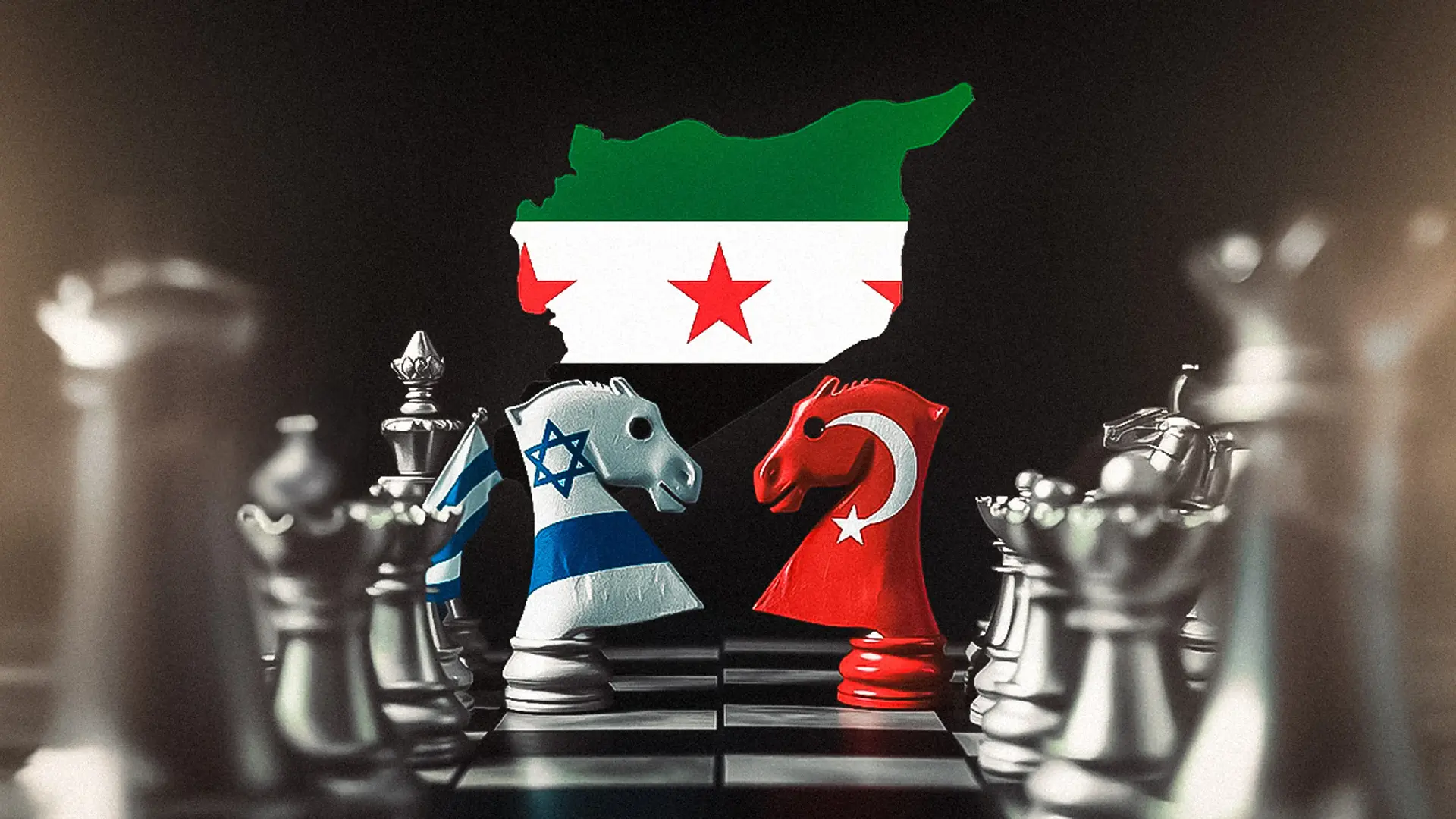
iNNOV8 has released a new strategic paper, “From Assad to Al-Sharaa: The Geopolitical Realignments and External Influences in Modern Syria,” arguing that the fall of Bashar al-Assad’s regime has opened a new phase of regional competition in Syria, led primarily by Turkey and Israel.
Written by researcher Shan Mohammed and dated 22 November 2025, the paper contends that the collapse of Assad’s decades-long rule and the rise of Ahmed al-Sharaa, a former commander of Tahrir al-Sham (HTS), have created a security vacuum that regional powers are racing to fill, each with a very different vision for Syria’s future.
This paper sheds light on the ways Türkiye and Israel’s security interventions are reshaping Syria’s post-Assad political order and the nature and extent of their interventions
Shan Mohammed writes in the executive summary.
A fractured state after Assad
The study revisits the core dynamics of the Syrian civil war, describing Syria as a “mosaic” of ethnic and religious communities whose diversity has made national unity difficult. It notes that, before the war, roughly 70 percent of the population were Sunni Arabs, alongside Alawites, Kurds, Christians, Druze, Armenians, Turkmen and others, and recalls that the state stopped collecting ethnic data in 1960.
Despite being a minority, the Alawite community dominated political power through the Assad family’s rule from 1970 to 2024. The paper estimates that more than 600,000 people, largely from the Sunni population, were killed over 13 years of conflict.
The author argues that the collapse of Assad’s regime in 2024 and the rise of Ahmed al-Sharaa as interim leader have fundamentally reordered Syria’s internal balance and invited intensive external involvement.
Competing regional projects: centralization vs decentralization
The central finding of the iNNOV8 paper is that Turkey and Israel are now pursuing opposing models for Syria’s political future.
Türkiye is presented as a first-rank ally of the new Sunni Islamist leadership in Damascus, advocating a unified, centralized Syrian state under a strong central government.
Israel, by contrast, is described as deeply wary of al-Sharaa’s background in HTS and more favorable to a decentralized Syria, backing minorities such as the Druze and Kurds to prevent any single hostile actor from dominating the country.
“Türkiye wants a strong and stable Syria,” the paper notes, “while Israel is more comfortable with a fragmented landscape that limits the power of any central authority and Iran’s reach.”
Turkey: security partner, trainer and economic gatekeeper
According to the study, Turkey has moved quickly to institutionalize its influence over the post-Assad state.
Key steps highlighted include:
- A memorandum of understanding on military training and consultancy between Ankara and Damascus, signed on 13 August 2025, which embeds Turkish doctrine and standards inside the resurrected Syrian army.
- Plans to deploy more troops and assets across northeastern Syria, especially in Kurdish-majority areas such as Hasaka and Raqqa, and to establish additional bases.
- A security strategy that insists there can be no autonomous Kurdish region and no armed entities outside the Syrian central authority.
The paper stresses that the entity which controls training often shapes “promotion, unit cohesion and rules of engagement,” raising questions over the long-term independence of the Syrian military.
Ankara’s doctrine is summarized as eliminating “cross-border insurgent infrastructure by reshaping Syria’s security sector itself,” with the integration and disarmament of Kurdish formations under Damascus treated as non-negotiable.
Economically, the paper notes that Türkiye seeks to:
- Revive a Qatar-Turkey gas pipeline route through Syria after Assad previously vetoed it.
- Dominate Syria’s post-war reconstruction market by expanding Turkish banks, telecoms, trade offices and industrial zones in northern Syria.
- Use control over border crossings such as Bab al-Hawa and Bab al-Salameh to influence trade and aid flows.
- Convert military control into long-term economic leverage, embedding Turkish influence through infrastructure, energy and trade corridors.
The study describes Turkey as aspiring to remain a key bridge between Middle East and Europe trade corridors, competing with projects such as China’s Belt and Road and the India–Middle East–Europe Economic Corridor (IMEC).
Israel: buffer zones, airpower and minority partners
On the Israeli side, the paper says security, not economics, drives policy in post-Assad Syria.
Its stated core objectives include:
- Securing a buffer zone along the Syrian border to prevent threats from Iran, Hezbollah, jihadist groups or uncontrolled chaos.
- Preventing the rearmament of Iranian proxies and the rebuilding of Syrian strategic weapons capabilities.
- Ensuring Syria cannot again become a platform for large-scale attacks on Israel.
After the 1974 disengagement accord collapsed with the fall of Assad, Israel expanded its presence beyond the Golan Heights, establishing positions around Quneitra, Daraa and other strategic points, while conducting an extensive airstrike campaign against Syrian military infrastructure and Iranian-linked targets. The paper cites Syrian government claims of hundreds of strikes and hundreds of ground incursions since Assad’s fall.
The author notes that this posture has drawn international criticism, but Israel justifies it as “defensive” and aimed at avoiding a repeat of the “southern Lebanon scenario.”
Israel’s limited economic interests in Syria are mostly tied to its hold on the Golan Heights, where an Israeli-American company has claimed the presence of substantial oil-bearing rock. The study stresses that any gains there remain secondary to Israel’s overarching security doctrine.
Politically, the paper says Israel is:
Deepening ties with the Druze in southern Syria, supporting calls for special administrative status that would limit the reach of Damascus and Iran in those areas.
Quietly viewing the Kurds in northeastern Syria as “natural allies” and a counterweight to both extremist groups and Iranian influence, even as this raises Turkish anxieties about a potential Kurdish proto-state along its border.
Gulf states as secondary but significant players
The iNNOV8 paper also situates Türkiye and Israel’s contest within a second layer of influence from Gulf Arab states such as Qatar, Saudi Arabia and the UAE.
It argues that:
During the Assad era, Gulf states pursued regime change, backed opposition groups and sought to weaken the Iran–Hezbollah axis.
Under al-Sharaa, they have shifted toward pragmatic engagement, seeking to stabilize Syria, limit Iranian dominance and prevent Türkiye from becoming the unrivaled external power.
Qatar is portrayed as remaining closest to Turkey’s position, while Saudi Arabia and the UAE adopt a more normalization-focused approach that accepts al-Sharaa’s rule as part of the new regional landscape.
Competing visions for Syria’s future
In its conclusion, the paper frames Syria as a battleground of overlapping regional projects rather than a solely internal conflict.
Türkiye seeks to shape Syria into a centralized, friendly and Sunni-aligned state that suppresses Kurdish separatism
Shan Mohammed writes.
Israel, by contrast, prefers a decentralized Syria that constrains both Damascus and Tehran and relies on minorities such as the Druze and Kurds to stabilize its borders.
The study warns that these contradictory strategies, combined with shifting Gulf policies, could drive Syria toward centralization, fragmentation, or a hybrid outcome, depending on how power is ultimately shared among Damascus, Ankara, Tel Aviv and their local partners.
iNNOV8’s new paper positions Syria’s post-Assad future not as a settled trajectory, but as an evolving arena where regional powers are actively rewriting the political map.
Read the full paper here: From Assad to Al-Sharaa: Geopolitical Realignments in Modern Syria
22/11/2025