Netanyahu Delivers Defiant UN Speech Slamming Critics And Iran
At a Glance
- During his UN address, Netanyahu predicted Iran's collapse and claimed walked-out nations "privately" thanked Israel for destroying Tehran's nuclear facilities.
- He rejected genocide accusations against Israel as the "greatest lie of the century," asserting that the IDF is a "moral army" while outlining civilian evacuation warnings.
- The Prime Minister dismissed Western criticism by arguing that Britain and France "invented" colonialism.
- Netanyahu labeled Turkish President Erdogan a "tyrant" for harboring Hamas leaders and rejected Syrian claims by stating that "Jews have been on the Golan Heights since the days of Moses."
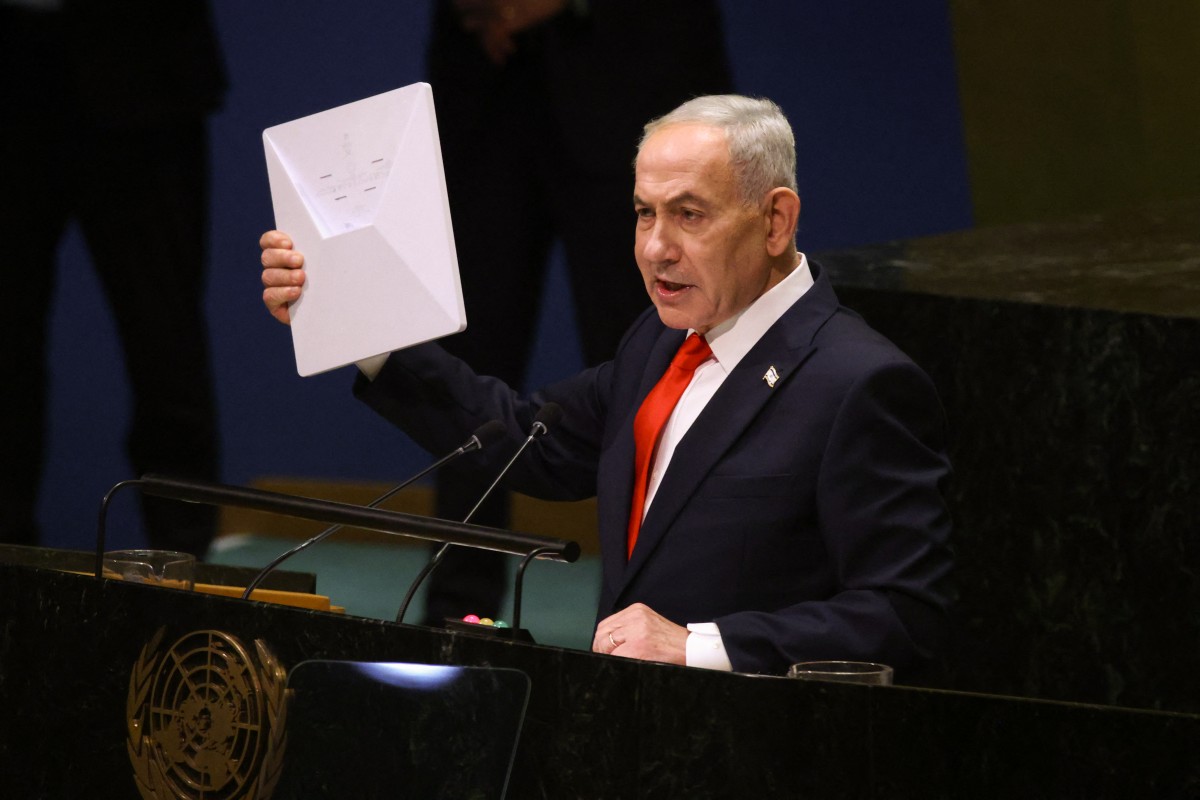
Israeli Prime Minister Benjamin Netanyahu told the UN General Assembly that the collapse of the Iranian government is bound to happen, adding that Israel continues to defend itself and those countries whose delegations left the hall, noting they privately thanked Israel for destroying Tehran’s nuclear facilities.
Key Statements and Focus Area
- The Israeli Prime Minister stated that "it's only a matter of time that in Iran something incredible will happen."
- Netanyahu stressed that "Israel didn't commit genocide. Israel prevented genocide."
- Netanyahu criticized Britain and France for accusing Israel of colonialism, asserted historical claims over the Golan Heights to Syria, and condemned Turkey for hosting Hamas.
Beginning his address at the General Assembly on Thursday, several delegations walked out of the hall, to which Netanyahu reacted, "If there are any other moral cowards who have not yet left this hall, please do so now. Thank you very much."
Netanyahu told the UN General Assembly that many walked-out nations privately thanked Israel for destroying Iran's nuclear facilities.
Predictions on Iran
Netanyahu emphasized that Iran’s "murderous regime will be toppled by its lies, by its corruption, by its cruelty. This evil regime will fall, and we will all celebrate."
"I want you to listen to my words carefully. One day, and it may not be far away, the Iranian people will be free," he said, adding that "the power of the people will overcome the people in power."
Gaza Operations & Civilian Warnings
The Prime Minister stated that while Hamas actively placed Palestinian civilians in danger, Israel made every effort to move them to safety.
He said that Israel sent millions of text messages, made millions of phone calls, and dropped millions of leaflets to warn civilians to leave combat areas.
Rejection of Genocide Claims
"Accusing Israel of genocide is the greatest lie of the century," he affirmed, adding that "the most moral army in the world: the IDF."
Netanyahu labeled Hamas members "terrorist monsters" and reminded the assembly of the horrific scale of the October 7, 2023, attacks.
He vowed that Israel would "finish the job" against the group and fiercely rejected the allegations of genocide being brought against Israel at the UN, calling them "the biggest lie of the century."
Feud with Turkey's Erdogan
Netanyahu called Turkish President Recep Tayyip Erdogan a "tyrant" and accused Ankara of harboring Hamas militant leaders.
"Tyrants the world over seek to threaten us. They seek to undermine our resolve with their campaign of lies. But ultimately, as on the military battlefield, the Jewish people will prevail," Netanyahu remarked.
“Erdogan calls for Israel's destruction. Almost every single day, he says he's going to be the ruler of Jerusalem. No, sir, you won't. This is our country, our city, our eternal capital,” he continued.
He underlined that the nation has become the latest country to become a super "spreader of antisemitic lies."
Disinformation Campaigns
The Prime Minister asserted that "several foreign countries have spent untold billions to spread lies about my country," explicitly identifying Qatar as the first to do so.
Golan Heights Dispute
Addressing Syrian representative Ahmed al-Sharaa directly, Netanyahu defended Israel's presence on the Golan Heights.
He stated, "Jews have been on the Golan Heights since the days of Moses. You can read it in the Bible."
Criticism of Britain & France
Netanyahu fired back at Britain and France for accusing Israel of "colonialism". Dismissing the allegations, he stated, "For God's sake, they invented the term. Their colonies spanned the globe. Colonialism? Give us a break."
He also separately condemned French President Emmanuel Macron for claiming Hamas wasn't active in the West Bank, calling Macron's comments a "grotesque absurdity" given the ongoing attacks against Israelis in the territory
“The leaders of these countries have chosen to succumb to the antisemitic mobs,” he added.
FYI
The war in Gaza began following the Hamas-led attacks on October 7, 2023, which resulted in approximately 1,200 deaths in Israel and the abduction of 251 hostages.
A significant turning point occurred via a U.S.-mediated ceasefire agreement in October 2025, which facilitated the release of all remaining living hostages and led Hamas to formally dissolve its governing body in Gaza.
The agreement established a transitional framework managed by a non-political Palestinian technocratic committee (the National Committee for the Administration of Gaza) under international supervision. However, long-term stabilization plans remain stalled.
While international bodies have proposed multi-billion dollar reconstruction plans, the security situation remains fragile due to unresolved terms regarding the full disarmament of militant factions and the exact parameters of Israeli security oversight.
Meanwhile, Tensions between Israel and Iran escalated significantly into a direct, large-scale military confrontation in early 2026, involving extensive joint U.S. and Israeli airstrikes targeting Iranian military command structures, air defense networks, and industrial assets.
A major focus of international concern centers on Iran's nuclear program. Israel has consistently maintained that pre-emptive actions are required to prevent Tehran from developing a functional nuclear weapon.
Conversely, Iran has repeatedly rejected Western and Israeli intelligence assessments, maintaining that its remaining facilities, including fortified subterranean complexes near Natanz, are designed exclusively for civilian energy and medical research.
The regional landscape is further complicated by severe international economic sanctions implemented by the United States, which have targeted Iranian aviation and trade sectors.
Friction between Israel and several Western European nations has also intensified, primarily driven by differences over security operations and governance in the Palestinian territories.
In global diplomatic forums, representatives from Britain and France have frequently criticized long-standing Israeli settlement policies and West Bank security measures, occasionally framing the dynamic through the historical lens of modern colonialism.
These policy rifts widened further due to public disagreements regarding the operational footprint of militant factions outside of the Gaza Strip.
While European leaders have occasionally downplayed the systemic presence of organized armed groups in the West Bank, Israeli defense officials point to localized intelligence networks and active recruitment cells as justification for ongoing counterterrorism operations in the area
The geopolitical alignment of neighboring states remains a source of sharp division. Relations with Turkey have deteriorated significantly due to Ankara's open diplomatic relationship with Hamas. Turkish President Recep Tayyip Erdogan has maintained a critical stance against Israeli military strategies, while Turkey continues to politically host members of Hamas's leadership bureau.
Israel strongly objects to this arrangement, viewing it as the active harboring of a hostile entity. Concurrently, Israel and Syria remain locked in a decades-long territorial dispute over the Golan Heights. Backed by historical United Nations resolutions, Damascus continues to demand a complete Israeli withdrawal from the territory, a position that Israel rejects on both strategic security and historical grounds
Dive Deeper: Handpicked Stories for You
Follow Channel8 for continuous updates:
Trump, Xi Convene to Advance Trade and Super Intelligence
.jpg)