Barzani and Al-Zaidi Agree on Constitutional Mechanisms to Resolve Disputes
At a Glance
KRG and federal prime ministers agreed on constitutional mechanisms to resolve outstanding fiscal and oil disputes.
A new joint framework guarantees continuous public sector salaries on an equal footing with federal state payrolls.
Iraq aims to boost national oil production to 10 million barrels per day by 2032, incorporating Kurdish fields.
Both leaders strongly condemned the recent terrorist attack targeting the Khor Mor energy infrastructure.
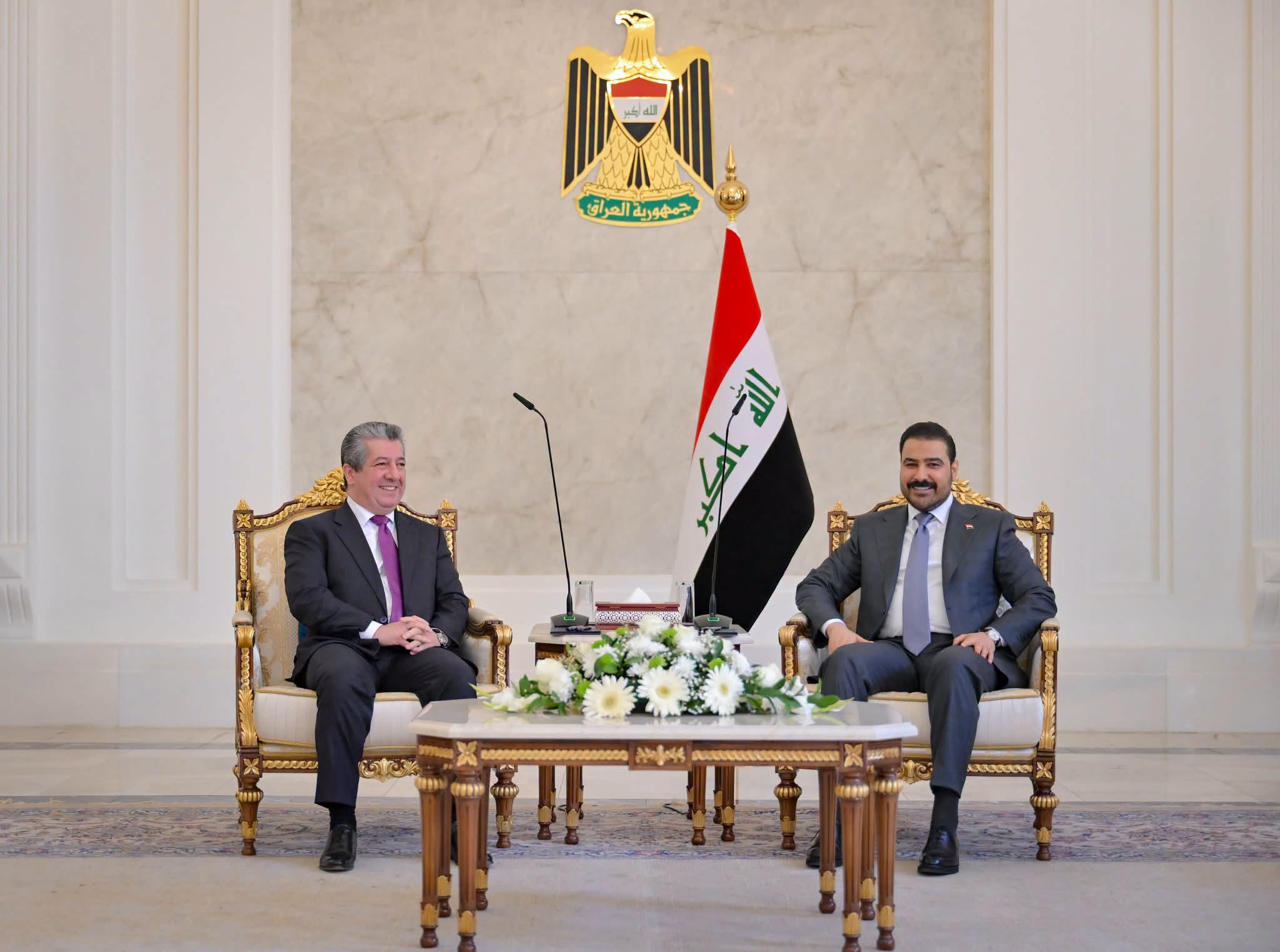
Masrour Barzani, Prime Minister of the caretaker Kurdistan Regional Government, met with Iraqi counterpart Ali Faleh al-Zaidi in Baghdad on Monday to discuss outstanding fiscal and oil disputes, agreeing to constitutional mechanisms for handling public salaries, the 2027 draft budget, and a long-term plan to boost national oil production.
Key Statements and Focus Area
The KRG said in a statement that Masrour Barzani “emphasized the importance of securing the Kurdistan Region’s share in the 2027 federal budget fairly, based on the Constitution, and with respect for the federal system and the constitutional status of the Kurdistan Region.”
“Both sides strongly condemned last night’s terrorist attack targeting the Khor Mor field,” the statement mentioned.
Meanwhile, the Iraqi Prime Minister's office said that al-Zaidi “affirmed the federal government’s strong commitment to achieving justice, safeguarding the constitutional rights of the Region’s citizens and institutions, and working to address all outstanding issues in a manner that serves the supreme national interest of all our people.”
The high-level meeting established a joint framework to constitutionally regulate oil field management, coordinate oil and non-oil revenues, expedite the federal Oil and Gas Law, and secure the Kurdistan Region's fair share of the 2027 general budget alongside guaranteed civil servant salaries.
According to the Kurdistan Regional Government, both sides agreed on the critical necessity of halting all attacks targeting the region's economic and energy infrastructure.
The Iraqi Prime Minister unveiled ambitious long-term energy plans to boost national oil production to 7 million barrels per day by 2030 and 10 million barrels per day by 2032.
The expanded target accounts for output from fields within the Kurdistan Region, which are projected to contribute approximately one million barrels per day to the national total.
Barzani “reaffirmed that this increase would positively impact the development and economy of Iraq.”
The two leaders held extensive discussions regarding the Kurdistan Region's constitutional rights and outstanding financial entitlements.
The Prime Minister of the Kurdistan Regional Government and the Iraqi Prime Minister officially addressed multiple critical areas to resolve outstanding issues between the administrations.
Discussions focused heavily on establishing functional "mechanisms for managing and regulating oil fields based on the Constitution," alongside specific measures to regulate oil and non-oil revenues through close coordination between the respective Ministries of Finance.
A central priority was safeguarding public sector workers, with both sides emphasizing the "necessity of ensuring the continuous disbursement of salaries to the employees of the Kurdistan Region" on an "equal footing with federal Iraqi employees."
Furthermore, negotiators worked to ensure that allocation mechanisms for the 2027 Federal Budget are grounded in the constitution to serve the "interests of all components of Iraqi society."
To permanently stabilize resource distribution, both delegations stressed the importance of "expediting the enactment of the Oil and Gas Law" to serve as a legal framework to regulate production and exports.
Ultimately, both sides emphasized "continuous coordination, mutual cooperation, negotiation, and understanding" as the true foundation to serve the interests of all state citizens.
FYI
Budget and "Actual Expenditure" Dispute
The financial friction between Erbil and Baghdad centers heavily on how the Kurdistan Region's budget share is calculated and disbursed.
Since 2015, the federal government has increasingly tied the region's funding to the framework of "actual expenditures," meaning funds are only allocated after deducting heavy federal sovereign and governing expenses from the national pool.
Kurdish officials have consistently argued that this calculation mechanism drastically slashes their actual cash receipts compared to the official percentage allocated on paper.
In practice, this structural accounting disagreement has led to chronic delays and multi-billion dollar shortfalls in federal transfers, frequently leaving the KRG unable to pay its public sector employees on time without relying on alternative financial measures.
The Civil Servant Salary Crisis
Securing public sector salaries has been the most volatile humanitarian and political issue between the two governments over the past decade.
Because the KRG economy relies heavily on public payrolls to sustain local livelihoods, any freeze or reduction in monthly cash transfers from Baghdad triggers immediate economic stagnation in the region.
Erbil maintains that under the Iraqi Constitution, regional civil servants are entitled to their compensation on an equal footing with any other state employee, free from political or budgetary standoffs. Baghdad, conversely, has historically conditioned salary disbursements on the systematic oversight of the regional payroll and the handovers of local revenues.
Oil Management and the Enactment of a National Law
The constitutional authority over oil production, field management, and independent exports remains a foundational point of contention.
Following a 2022 Iraqi Federal Supreme Court ruling that declared the Kurdistan Region’s independent oil and gas law unconstitutional, alongside the subsequent shutdown of the Iraq-Turkey pipeline in March 2023, the KRG’s independent oil export capabilities were halted.
Since then, both capitals have struggled to find a legally sound mechanism to regulate production costs, manage regional fields, and restart exports through state-owned channels.
Security Vulnerabilities at Energy Infrastructure Sites
The Khor Mor gas field, located in the Chamchamal district of the Slemani governorate, is a highly critical energy hub operated by the Pearl Petroleum consortium. It supplies the vast majority of the natural gas required to fuel power plants across the Kurdistan Region, making its uninterrupted operation essential for local civilian infrastructure.
Over the past several years, the facility has been the target of multiple drone and rocket attacks launched by unidentified armed groups, including a recent terrorist strike on Sunday night that prompted immediate, unified condemnation from both leaderships.
These security breaches have caused temporary halts in gas production, widespread electricity blackouts, and civilian casualties, prompting both Erbil and Baghdad to repeatedly call for synchronized security measures to protect vital state infrastructure.
Dive Deeper: Handpicked Stories for You
Follow Channel8 for continuous updates:
Erbil Slams Baghdad Over Sixty Five Trillion Dinar Budget Trap
Ahmed Mufti Tells Channel8 Iraqi Delegation Visits Khor Mor After Attack
Dana Gas Halts Production Following Khor Mor Drone Strike
KRG Prime Minister to Visit Baghdad to Discuss 2027 Budget Entitlements
 (1).webp)