Former U.S. Official: Trump Less Interested in KDP-PUK Disputes
At a Glance
Former U.S. official Victoria J. Taylor stated the Trump administration was less interested in mediating KDP-PUK.
Taylor warned that growing internal Kurdish divisions undermine a key U.S. partner in Iraq.
She stressed that significant U.S. government intervention was the critical factor preventing “a total rupture” until now.
Victoria J. Taylor, former U.S. Deputy Assistant Secretary of State for Iraq and Iran, stated that the administration of U.S. President Donald Trump was “much less interested” in mediation between the Patriotic Union of Kurdistan (PUK) and the Kurdistan Democratic Party (KDP) regarding government formation talks, warning that Kurdish divisions undermine a key U.S. partner in Iraq.
Key Statements and Focus Area
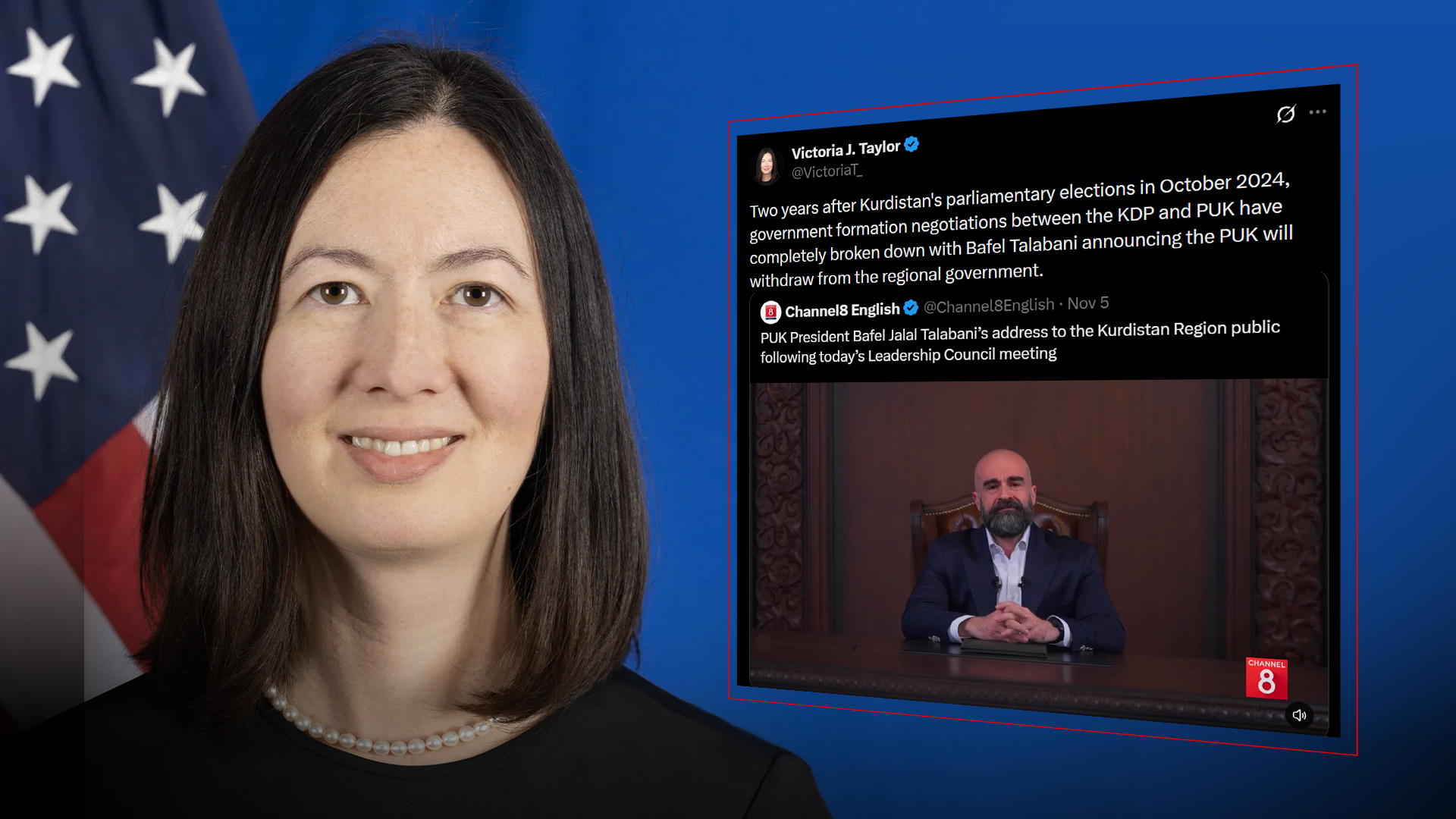
Reposting PUK President Bafel Jalal Talabani’s message in which he announced the party’s withdrawal from the government, Victoria J. Taylor wrote on X: “Two years after Kurdistan's parliamentary elections in October 2024, government formation negotiations between the KDP and PUK have completely broken down with Bafel Talabani announcing the PUK will withdraw from the regional government.”
“I get the Trump admin instinct: why should the US be involved and why is this our problem? And yet, the divisions within Kurdistan undermine the strength of one of the strongest US partners in Iraq,” she noted.
The former U.S. official stated that during the period between the Kurdistan parliamentary elections in October 2024 and recent developments, she held extensive talks with the KDP and PUK, emphasizing that on multiple occasions the two parties “appeared close to reaching a compromise.”
“Yet, during all my visits there was only one visit during which the two sides did not bitterly complain about each other to me. Put simply, they just don't trust each other,” she added.
Taylor stressed that significant U.S. government intervention had been a critical factor in preventing “a total rupture” between the parties until now.
“The Trump administration was much less willing to or interested in playing the role of mediator between the KDP and PUK,” she highlighted.
The former official underlined that previous U.S. administrations were fully prepared to involve themselves directly in internal Kurdish politics and exert pressure on leadership when necessary.
She recalled that the United States played a critical role in brokering the agreement that ultimately allowed the delayed October 2024 regional elections to take place.
“I am really disappointed to see this news. It's bad for Kurds, bad for Kurdistan, and bad for American interests,” she remarked.
FYI
Victoria J. Taylor’s statements come after PUK President Bafel Jalal Talabani issued a message to the Kurdistan Region on Thursday in response to the recent election of the parliamentary presidency without the participation of major political blocs.
In his message, Talabani announced the withdrawal from the “failed” government, adding that he tried several times to form a service-oriented cabinet with the KDP, but whenever progress was made, “they ruined it with an excuse.”
Reactivated at the KDP's request without major blocs present, the Kurdistan Parliament appointed Vala Fareed as Speaker, Rami Nouri as Deputy Speaker, and Muna Qahwachi as Secretary with 52 lawmakers.
Before the assembly call, the PUK criticized the session, describing it as “illegal” and a clear attempt to “impose the will of a single party.”
Talabani refused to recognize the session as a parliamentary convention and its subsequent outcomes, stating, “No. The parliament has not convened. A minority within the Kurdistan Democratic Party, who proved that today, do not know what democracy is.”
He warned, “Whatever you do over there, we will do over here,” declaring that any unilateral appointments of a regional president, prime minister, or ministers would be met with mirrored appointments.
The October 20, 2024, Kurdistan Region parliamentary elections concluded with the KDP securing a 39-seat plurality and the PUK winning 23 seats.
The KDP advocated for an electoral-majority model, arguing that its 39-seat plurality entitled it to lead the Region's executive and legislative institutions.
The PUK demanded a power-sharing model based on political consensus and a genuine partnership in strategic decision-making.
The PUK formed an alliance with the New Generation Movement earlier this year, creating a joint 38-seat front that insisted on negotiating government formation as a single package.
The KDP refused to recognize the alliance as a single negotiating partner, insisting instead on conducting separate bilateral talks with individual political parties.
In the meantime, several initiatives launched by other political parties also failed to reach a definitive conclusion.
Dive Deeper: Handpicked Stories for You
Follow Channel8 for continuous updates:
PUK President Announces Withdrawal From KRG Government, Rejects Parliament Session Outcomes
KDP Says Parliament Reactivation Not Directed Against Any Political Party
Nechirvan Barzani Urges Active Political Participation in Reactivated Kurdistan Parliament
Barzani Congratulates Kurdistan on Parliament’s Reactivation, Calls for Political Participation
Kurdistan Parliament Elects New Presidency Amid Major Party Boycott