How Archaeologists Unearth and Preserve Kurdistan's Past
At a Glance
- Excavation follows a systematic scientific process
- Specialists work together across disciplines
- Artifacts are carefully recorded and preserved
- Archaeology helps reconstruct undocumented history
Archaeological excavation is a collaborative scientific process that combines fieldwork, advanced technology, and expertise from multiple disciplines to uncover, document, preserve, and interpret evidence of ancient human societies.
Key Statements and Focus Area
- Sites are surveyed, mapped, divided into grids, and excavated layer by layer.
- Artifacts and structures are photographed, catalogued, and assigned precise coordinates before removal.
- Finds are transported to field laboratories for cleaning, conservation, and further study.
- Archaeology helps preserve heritage, fill gaps in written history, and support cultural tourism.
According to the General Directorate of Antiquities and Heritage of the Kurdistan Regional Government, archaeological excavation requires patience and close collaboration between specialists.
The process begins with preliminary research and archaeological surveys to identify potential historical sites. Researchers review historical sources and conduct scientific examinations of the terrain and surface remains.
Successful archaeological work requires teams with expertise across several fields.
These may include archaeologists, experts in ancient languages, geologists, anthropologists, chemists specializing in material analysis, paleoethnobotanists, and zooarchaeologists.
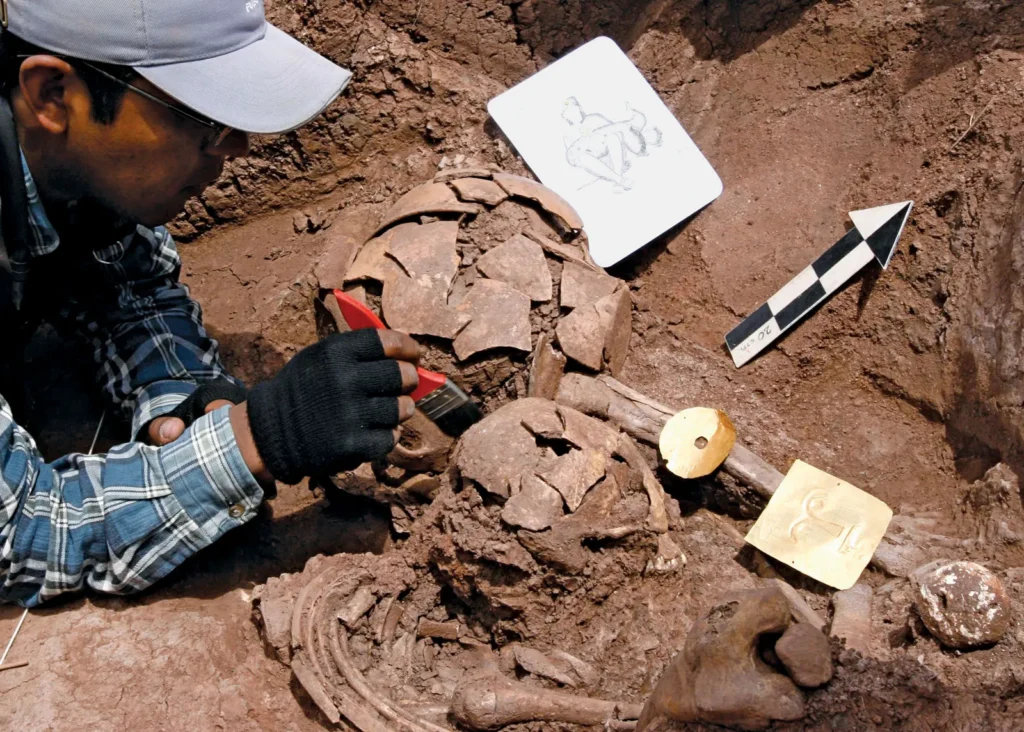
Excavation teams use tools ranging from shovels and trowels to soft brushes, specialized dental picks for detailed work, and protective gloves.
Advanced equipment can include high-resolution cameras, drones, Total Stations, GPS devices, dumpy levels, ground-penetrating radar, and other geophysical technologies, as well as chemical testing equipment.
Researchers also rely on field notebooks, site maps, computers, geographic information systems (GIS), and databases to document their work.
Before excavation begins, archaeologists establish the boundaries of the site and divide the area into a coordinate grid or smaller excavation squares.
The layout is adapted to the site's characteristics, topography, and research requirements, allowing findings to be systematically recorded and their exact locations documented.
Archaeologists excavate sites stratigraphically, moving from newer layers toward older ones.
As historical remains accumulate over time, deeper layers generally represent earlier periods. Researchers therefore document each layer carefully to understand the sequence of occupation and activity at the site.
Every discovered artifact or architectural feature, such as a wall, is assigned precise coordinates and a unique catalogue number.
Items are photographed with identification tags before being removed from their original locations.
After excavation, discovered objects are carefully transported to field laboratories.
There, they can undergo scientific cleaning, chemical preservation, and further academic examination.
The process helps protect artifacts from deterioration while allowing researchers to study their materials, origins, uses, and historical context.
Archaeology plays several roles in understanding human history.
It helps preserve cultural heritage from destruction, deterioration, and loss while providing evidence about how earlier societies lived, organized their economies, built structures, practiced religion, and expressed themselves through art.
Archaeological research is particularly important for periods without written records, including prehistoric eras, where material remains may provide the primary evidence available for reconstructing the past.
It can also contribute to cultural identity and tourism by documenting and presenting historical heritage to the wider international community.
FYI
Archaeological excavation does not rely solely on digging. It combines archaeology with complementary sciences and technical methods to identify, document, analyze, preserve, and interpret evidence. The use of surveying technologies, geophysics, laboratory analysis, GIS, and specialized scientific expertise allows researchers to answer questions that cannot be resolved through excavation alone.
Dive Deeper: Handpicked Stories for You
Follow Channel8 for continuous updates:
Hawar Theater Group Takes "Behind Closed Doors" to Tunisia International Festival
09/08/2026