Joe Kent Highlights Bafel Jalal Talabani’s Diplomatic Role In Tehran
At a Glance
- Former U.S. counterterrorism official Joe Kent described PUK President Bafel Jalal Talabani as a longstanding U.S. ally in the region.
- Kent recalled cooperation between U.S. forces, Kurdish Peshmerga and Iran-backed forces during the campaign against ISIS.
- Talabani, president of the Patriotic Union of Kurdistan, recently held talks with senior Iranian officials in Tehran.
- Kent said he hopes Talabani’s diplomacy can contribute to reducing tensions and promoting regional stability.
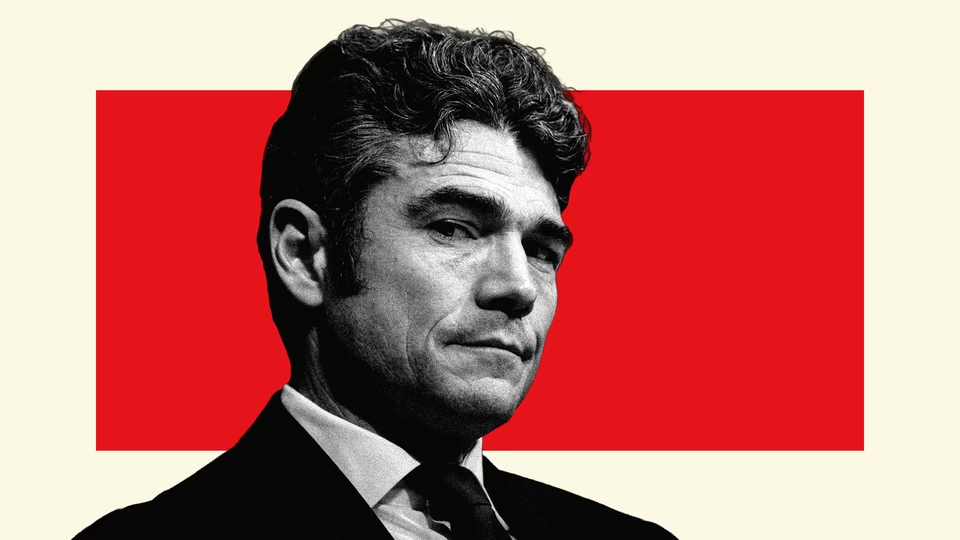
Joe Kent, former Director of the U.S. National Counterterrorism Center, has highlighted Patriotic Union of Kurdistan President Bafel Jalal Talabani’s diplomatic role as he engages with Iranian officials in Tehran.
Kent pointed to the previous cooperation between U.S. forces, Kurdish Peshmerga and Iran-backed forces in the campaign against ISIS, saying Talabani’s current diplomacy could contribute to greater regional stability.
Speaking on The Glenn Diesen Podcast, hosted by Norwegian political scientist and author Prof. Glenn Diesen, Joe Kent discussed the history of U.S.-Iranian cooperation against ISIS, the role of Kurdish forces in the campaign, and Bafel Talabani’s current diplomatic engagement with Tehran.
KEY STATEMENTS
“We still have a lot of, I think, good allies in the region who were there for that.”
— Joe Kent, referring to the former campaign against ISIS
“Bafel Talabani... he’s currently over in Tehran right now.”
— Joe Kent
“Bafel’s forces, the PUK, and the KDP were key to us being able to fight against ISIS.”
— Joe Kent
“I’m hoping that Bafel’s diplomacy over there is able to bring some, you know, stability to the region as well.”
— Joe Kent
U.S.-KURDISH COOPERATION AGAINST ISIS
Kent recalled his experience in Iraq in 2016, when he served as a U.S. Special Forces adviser working with the Peshmerga.
He said Kurdish forces played a central role in the ground campaign against ISIS, while also pointing to the role of Iraq’s Popular Mobilization Forces and Iranian military advisers in operations against the militant group.
Kent described the relationship as an example of U.S. and Iranian interests overlapping in the fight against ISIS, despite their broader strategic differences.
His comments specifically highlighted the role of both the PUK and KDP forces in supporting the campaign against the militant organization.
BAFAEL TALABANI IN TEHRAN
Talabani travelled to Tehran on September 15 at the invitation of Iran’s Foreign Ministry and held meetings with senior Iranian officials. Iranian Foreign Ministry spokesman Esmaeil Baghaei said the visit was part of consultations involving Iran, Iraq and the Kurdistan Region, with discussions expected to include economic cooperation and border security.
During the visit, Talabani met Iranian President Masoud Pezeshkian, Foreign Minister Abbas Araghchi and Parliament Speaker Mohammad Bagher Ghalibaf, among other officials.
Talabani said the Kurdistan Region would not become part of wars or conflicts and stressed dialogue and de-escalation. Iranian officials also publicly acknowledged his stated role in efforts aimed at reducing tensions.
DIPLOMACY AND REGIONAL STABILITY
Kent’s comments place Talabani’s Tehran engagement within a wider regional context in which Kurdish actors maintain relationships with both Western governments and neighboring states.
Talabani’s recent discussions in Tehran have focused on regional political and security developments, border security, bilateral relations and efforts to reduce tensions.
For Talabani, the diplomatic challenge involves maintaining the Kurdistan Region’s security and interests while navigating relations among Baghdad, Tehran, Washington and other regional actors.
FYI
Kent’s remarks connect the Kurdish role in the anti-ISIS campaign with Talabani’s current diplomatic engagement in Tehran. His account highlights that U.S., Kurdish and Iranian-backed forces previously operated in parallel against a common threat, while Talabani’s current meetings are focused on dialogue, de-escalation and regional security. Whether that diplomacy can produce broader stability remains dependent on the positions and actions of the wider regional actors involved.
Dive Deeper: Handpicked Stories for You
Follow Channel8 for continuous updates:
Channel8 Exclusive: Joe Kent On Collapse Of Diplomacy And Start Of Iran War
.jpg)
.webp)