Yellowstone Supervolcano: A Potential Threat More Powerful Than 100 Nuclear Bombs
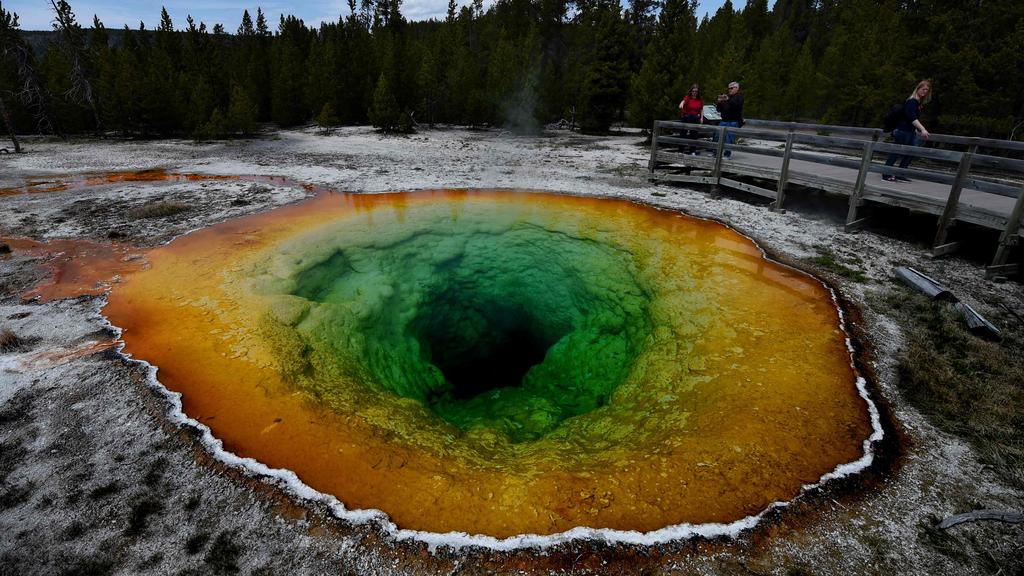
Recent research warns that an eruption of the Yellowstone Supervolcano—located beneath Yellowstone National Park in Wyoming—could trigger catastrophic consequences, unleashing energy equivalent to 875,000 megatons of TNT, more than 100 times the total force of all nuclear bombs ever detonated.
The Threat of a Super-Eruption
According to a report by the Daily Mail, the Yellowstone Supervolcano, which last erupted over 640,000 years ago, holds a massive magma reservoir capable of producing a super-eruption far more powerful than any volcanic event recorded in human history. Scientists are now using artificial intelligence to model potential eruption scenarios and predict their devastating effects.
The latest simulations suggest that a Yellowstone eruption would begin with a colossal explosion, instantly creating a massive crater and killing approximately 90,000 people in the initial blast. The impact would not be limited to the immediate area, as dense clouds of ash, rock, and burning gases would surge outward at extreme speeds, obliterating everything in their path.
Widespread Destruction Across North America
Experts predict that any city within 50 miles (80 km) of Yellowstone—such as West Yellowstone, Montana—would be completely wiped out, much like Pompeii after the eruption of Mount Vesuvius in 79 AD.
However, the greatest danger lies in the fallout, as the eruption would eject massive ash clouds into the atmosphere, impacting not just the U.S. but the entire world.
-Ash would spread across most of North America, reaching cities as far as Miami and Los Angeles, regardless of wind direction.
-Casper, Wyoming, and parts of Montana could be buried under more than a meter of ash.
Major cities like Chicago, Seattle, and San Francisco could see ash layers up to 3 cm thick, potentially affecting infrastructure and daily life.
-Ashfall could even reach London, depending on atmospheric conditions.
A Global Volcanic Winter
Unlike typical fire ash, volcanic ash consists of heavy, sharp rock particles and glass, which can collapse buildings, destroy crops, and cripple transportation and communication networks.
Additionally, a Yellowstone eruption would release enormous amounts of sulfur dioxide into the atmosphere, blocking sunlight and triggering a global temperature drop.
-Scientists estimate that global temperatures could fall by 5°C over several years, with the first year seeing a 10°C drop.
-Some researchers predict a “volcanic winter” similar to the aftermath of the 1815 Mount Tambora eruption, which caused severe climate disruptions and widespread famine due to failed crops.
Given today’s globalized economy and interconnected supply chains, such an event would have far-reaching economic and political consequences worldwide, disrupting food production and leading to geopolitical instability.
Is an Eruption Imminent?
Despite the catastrophic scenarios modeled by scientists, there is no conclusive evidence that Yellowstone is on the verge of erupting. However, geologists continue to monitor the volcano closely for any signs of abnormal activity.
For now, while the supervolcano remains a potential threat, it is not considered an immediate danger—though its sheer destructive potential makes it one of the most closely watched geological sites on Earth.
25/02/2025