iNNOV8 Paper: Unemployment, Neglect Fuel Ongoing Migration from Kurdistan’s Pshdar to Britain
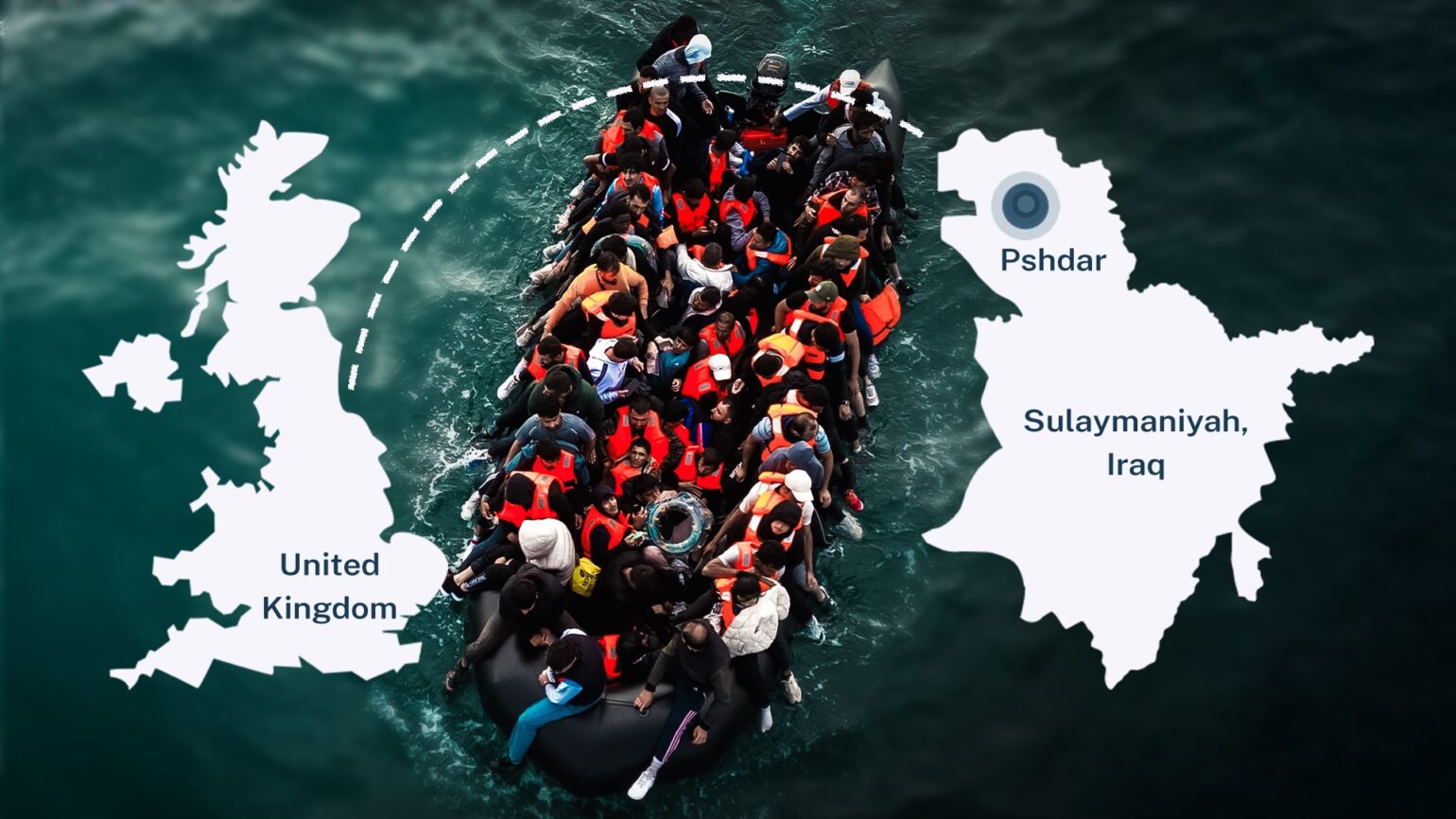
The mountains of Pshdar, once known for their resilience and self-reliance, are today exporting something more fragile than goods: their youth.
iNNOV8’s latest paper on migration from Kurdistan’s Pshdar region highlights how unemployment, political instability, and lack of government investment are fueling a generational exodus to the UK.
[Read the full paper here →]
Today, another export defines the region: its youth. For decades, young men from towns like Ranya and Qaladiza have embarked on journeys toward the United Kingdom, a migration so organized and persistent that it has become less an exception and more a system one that replenishes itself with each departure.
Lack of prospects, a stagnant economy, negligence of certain areas by the government, and the continuous political and security instabilities in the Kurdistan Region of Iraq (KRI) have led a specific group…to leave their homeland and seek refuge elsewhere
the paper concludes.
Methodology: Listening to Families
Between February and May 2025, researchers conducted structured interviews with four randomly selected families in Pshdar, each with sons who had emigrated to the UK.
Confidentiality was key:
Names were withheld, consent was secured, and anonymity was guaranteed.
Why qualitative?
Because migration is not just a statistic, it is a web of decisions, pressures, and cultural norms. By gathering testimonies, the study captured nuances often lost in policy reports.
Thematic analysis:
Responses were examined for recurring patterns, linking economic hardship, societal pressures, and family dynamics into a broader picture of why migration persists.
Although small in sample size, the depth of responses gave researchers a powerful window into community dynamics, local frustrations, and the self-sustaining economy of migration.
A System Rooted in Home and Abroad
The study shows that migration from Pshdar is not random. It begins with a decision at the family table, often born from despair. A son, jobless and restless, chooses to leave. Families sell land, cars, or jewelry to fund the journey. Smugglers are contacted, routes through Turkey and Europe mapped out, and within weeks, the young man is on his way.
What makes the UK the favored destination is not just opportunity, but community. In cities across Britain, Kurds [Pshdaris] who arrived in the 1990s and 2000s have built tight-knit support systems. They provide jobs, housing, and a sense of belonging to each new arrival. Back home, news of a safe landing is celebrated; soon, remittances begin to flow, and the cycle renews with another brother or cousin preparing to depart.
The iNNOV8 report calls this a “self-sustaining economy of migration,” one that funnels both money and hope away from Kurdistan and toward diaspora hubs abroad.
The family sells land, a car, or jewelry for their son’s trip. The son embarks on a journey, arrives, and finds a job with the help of relatives and friends. The son pays back the debt…and continues to support the family back home with regular remittances
the paper explains, describing a cycle that is less a rupture than a routine.
Push and Pull: Why Pshdar Leaves
The push factors are familiar: unemployment, corruption, nepotism, and an absence of long-term prospects in the KRI. The pull factors are equally strong: steady, if low-paying, jobs in Britain; security; and the prestige of supporting one’s family from abroad. Together, they create a powerful gravitational force pulling Pshdar’s youth westward.
But the study highlights another layer: societal pressure. In Pshdar, having a son in the UK is not just survival, it is status. Families that once sought academic achievement abroad now prioritize immigration status. To stay behind is, for many, to risk being trapped in a cycle of drugs, smuggling, or idleness. To leave is to claim dignity.
The Cost and the Calculus
The journey is perilous and expensive. Families spend between $16,000 and $20,000 per migrant, sums raised by selling assets or borrowing. Yet the investment often pays back: sons repay debts quickly, then send regular remittances. For parents, the logic is grim but pragmatic. Funding migration is cheaper than trying to secure a future for their sons at home.
Smugglers, many embedded within local networks, ensure that the journey remains viable despite risks. The report notes that even the dangers of the Mediterranean or the English Channel are outweighed by the promise of a job in London or Manchester.
What Is Lost
The report poses a stark question: what becomes of a region when its brightest and strongest depart? Each young man who leaves could have been a teacher, a builder, or a business owner in Pshdar. Instead, he becomes a laborer abroad. The cycle not only empties villages but also reshapes values, replacing collective investment at home with survival abroad.
“The referendum of 2017 showed the will of a nation,” the report notes, “but migration shows its despair.” Both are votes of a kind, one for sovereignty, the other for escape.
Policy Blind Spots
The British government has tried to curb the flow, funding awareness campaigns about the dangers of illegal migration and even threatening deportation to Rwanda. But such measures barely scratch the surface. As long as Pshdar’s youth see no future at home, no campaign can stem the tide.
For the KRG, the challenge is existential. Without investment, reform, and serious attention to marginalized regions like Pshdar, migration will continue. The study urges anti-corruption measures, job creation, and education reforms. It also calls for joint UK-KRG studies into the social costs of this exodus.
A Future Written in Departures?
Migration from Pshdar is not a new story. It began in the 1990s, when instability and poverty pushed families to risk everything. But as iNNOV8 shows, what began as necessity has now hardened into tradition. Each departure is celebrated, not mourned. Each remittance cements the logic of leaving.
Unless the roots of despair are cut, the exodus will continue. The question is not whether more sons of Pshdar will leave, but whether anyone will remain to carry on the work of building a future at home.
25/09/2025