White House Family Theater Demolished Amid East Wing Reconstruction

One of the most iconic features of the White House, the Family Theater, has been demolished as part of President Donald Trump’s $300 million East Wing reconstruction project, which will replace the historic section with a grand ballroom.
The small, 42-seat cinema, often described as “Hollywood’s most exclusive screening room,” had been a presidential retreat since 1942, when Franklin D. Roosevelt converted a cloakroom in the East Terrace into a private theater. Its destruction marks the end of a storied era in White House history that bridged entertainment, politics, and culture for over eight decades.
From Roosevelt’s Newsreels to Hollywood Screenings
According to the White House Historical Association, Roosevelt had the space fitted with a projector and screen so he could view wartime newsreels during World War II. The 32nd U.S. president, who oversaw the nation through the Great Depression and the global conflict, saw film as both a morale booster and a medium of influence.
“Entertainment is always a national asset — invaluable in peace, indispensable in wartime,” Roosevelt famously declared in 1943, highlighting his belief in cinema’s power to unify and inspire Americans.
While Roosevelt institutionalized the Family Theater, presidential film screenings predated its construction. In 1915, Woodrow Wilson held the first known White House movie screening — the controversial silent film The Birth of a Nation — in the East Room, underscoring early recognition of film’s political and cultural weight.
A Stage for Presidents and Pop Culture
For generations, the Family Theater became a symbolic window into presidential taste and leisure. Successive presidents used it for both official and private screenings.
According to the George W. Bush Presidential Library, events ranged from public screenings of documentaries to intimate family viewings. “The best perk in the White House is not Air Force One or Camp David,” former President Bill Clinton once said. “It’s the wonderful movie theatre, because people send me movies all the time.”
Over the decades, the décor of the theater evolved — from mustard curtains and green chairs in the mid-20th century to white seating and floral drapes under Lyndon B. Johnson, and eventually to its final all-red design introduced during the George W. Bush administration.
Memorable Presidential Screenings
The theater hosted countless memorable moments.
In 1977, Jimmy Carter briefly imposed a “family-friendly” film policy — only to accidentally screen Midnight Cowboy, the first X-rated film to win an Academy Award.
In 1982, director Steven Spielberg screened E.T. the Extra-Terrestrial for Ronald and Nancy Reagan. Recalling the night, Spielberg said Reagan turned to the audience — which included Sandra Day O’Connor and several astronauts — and quipped, “There are a number of people in this room who know everything on that screen is absolutely true,” prompting laughter.
Reagan’s only complaint? “The credits were too long,” Spielberg said with a grin decades later.
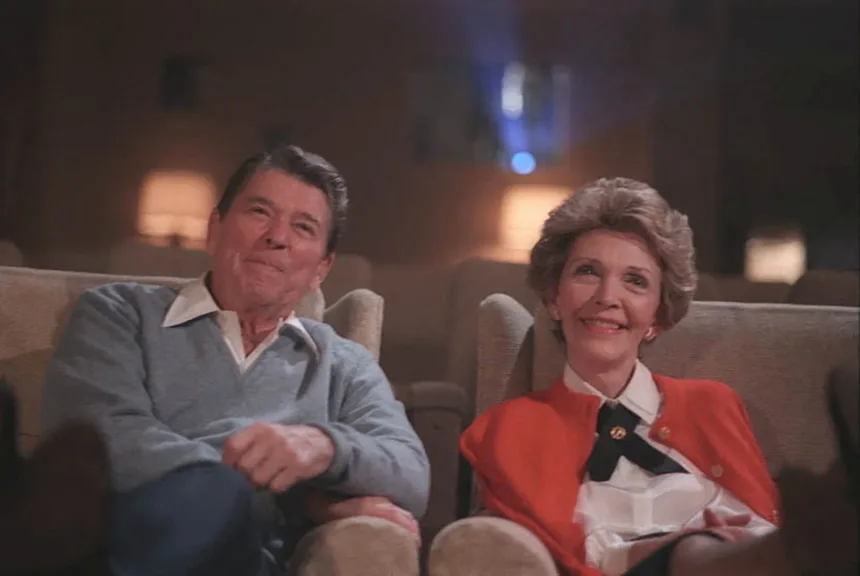
Reagan Library/Handout
End of an Era
The Family Theater was one of several heritage spaces in the East Wing, which historically housed the First Lady’s offices, the White House Social Secretary, and military aides. The East Wing’s architecture, dating back to 1942, complemented the West Wing and served as the main entrance for guests attending White House social events.
Its demolition — part of President Trump’s larger plan to construct a 90,000-square-foot ballroom — has drawn criticism from the National Trust for Historic Preservation and architectural historians, who warn that it risks “overwhelming the scale and classical balance” of the original James Hoban design.
White House officials have defended the project, calling it “a visionary modernization of America’s executive residence,” and noted that it is privately funded.
As excavators continue their work on the East Wing, the echoes of laughter, applause, and presidential reflection that once filled the Family Theater are now part of White House history — a vanished chapter of cinematic and political nostalgia.
25/10/2025