5,000-Year-Old Monument Unearthed in Sulaymaniyah May Redefine Ancient Urban Networks
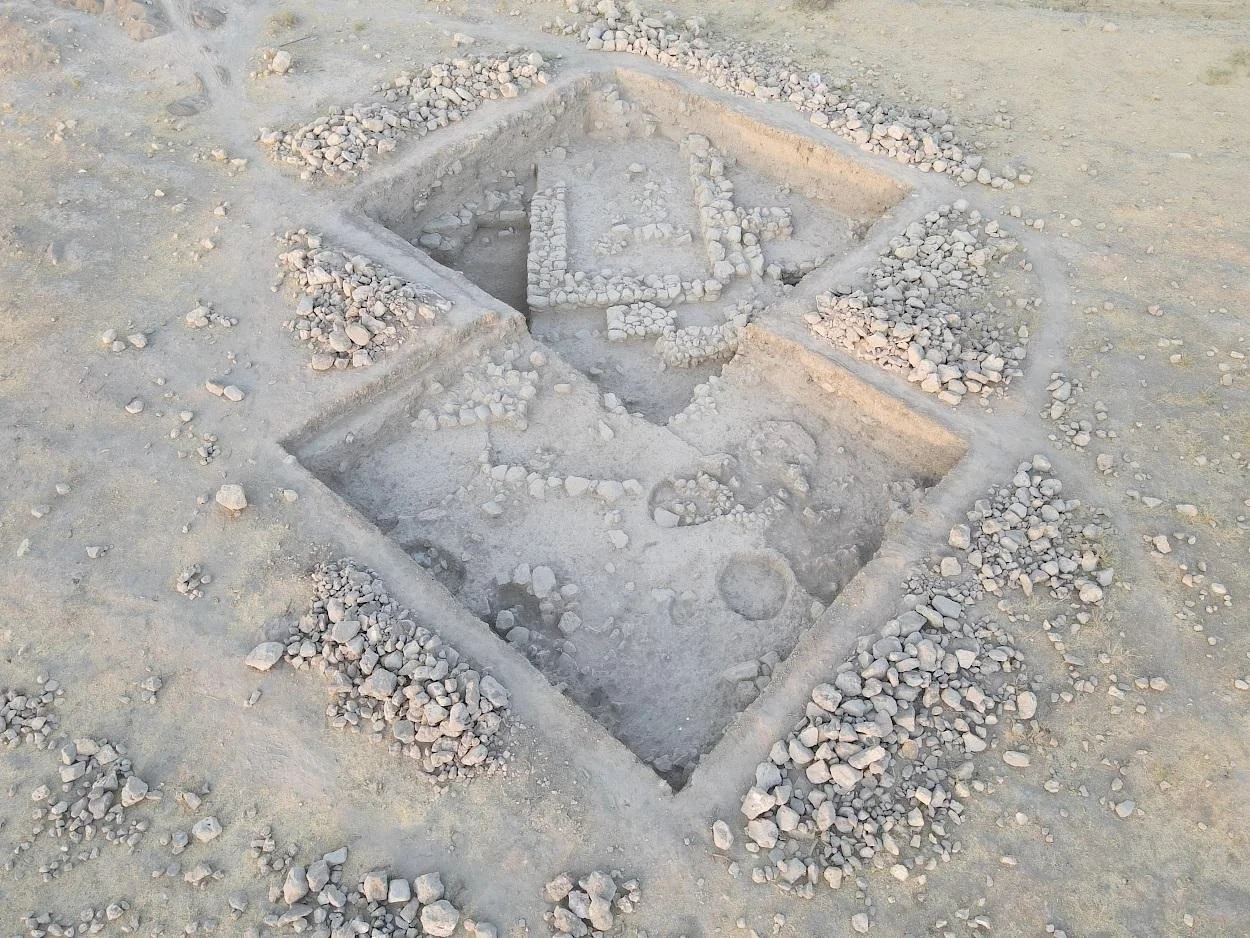
Archaeologists have uncovered a monumental structure in Kurdistan’s Sulaymaniyah that could reshape our understanding of early urban civilization.
The discovery, made at the Kani Shaie site in Sulaymaniyah Governorate, dates back to the Uruk period (circa 3300–3100 BCE), a formative era in southern Mesopotamia’s urban development.
Led by the University of Coimbra’s Centre for Studies in Archaeology, Arts and Heritage Sciences (CEAACP), in partnership with the University of Cambridge and the Slemani Antiquities and Heritage Directorate, the Kani Shaie Archaeological Project revealed a large, officially constructed building atop a mound—likely a temple or cultic space used for ritual or administrative purposes.
Among the most striking features are decorative wall cones—colorful clay or stone elements embedded in plaster to form geometric mosaics—typical of southern Mesopotamian ceremonial architecture. Additional finds include a fragment of a gold pendant and cylinder seals, indicating access to luxury goods and involvement in administrative systems. These artifacts suggest Kani Shaie was a vibrant participant in regional cultural and political networks, not a remote outpost.
Located nearly 300 miles north of Uruk, the world’s first known metropolis, the site’s monumental architecture implies that Uruk’s influence extended deep into the Zagros foothills. This challenges the long-held view that highland communities were peripheral to the urban centers of the southern plains.
Excavations, ongoing since 2013, have revealed continuous human occupation from the Chalcolithic period (c. 6500 BCE) through the 3rd millennium BCE, with later layers from the Neo-Assyrian and Hellenistic–Parthian periods. These findings position Kani Shaie as a key site for studying early social and political evolution east of the Tigris River.
Funded by the Portuguese Foundation for Science and Technology (FCT) and supported by the University of Cambridge, the 2025 excavation season underscores the complexity and reach of ancient cultural networks across the Fertile Crescent.
06/11/2025