Scientists Sequence Ancient RNA From Woolly Mammoth, Offering Rare Clues to Final Moments
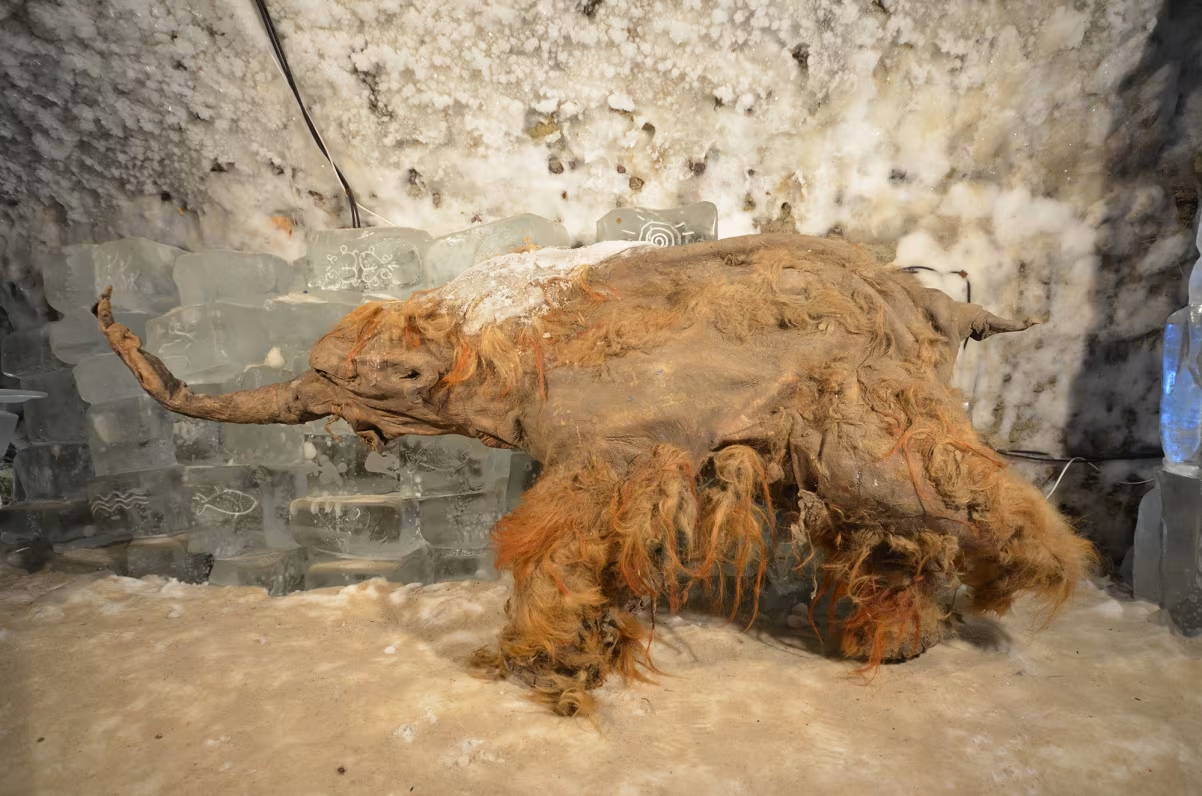
Scientists have sequenced ancient RNA from a 40,000-year-old woolly mammoth, marking the oldest RNA ever recovered and offering unprecedented insight into the biology of the extinct Ice Age animal shortly before it died.
The RNA fragments came from the mummified leg tissue of a juvenile mammoth known as Yuka, whose remains were discovered in 2010 in northeastern Siberia. The tissue had been preserved in permafrost for millennia, allowing researchers to extract molecules once thought too fragile to survive deep time.
The findings, published Friday in the journal Cell, detail how the team analyzed 10 samples of frozen mammoth tissue, including skin and muscle. Only three yielded fragments of RNA, and just one—Yuka’s tissue—provided enough material to reconstruct which genes were active at the time of death.
All the cells in an organism have the same DNA. What makes cells different from each other is essentially the RNA,
said Love Dalén, professor of evolutionary genomics at Stockholm University and the Swedish Museum of Natural History, and senior author of the study.
RNA acts as a messenger, reading DNA’s instructions and helping cells build proteins. Unlike DNA, which can last more than a million years under the right conditions, RNA was long believed to degrade quickly. The new research shows that, in exceptional environments like permafrost, RNA can survive far longer than expected.
The scientists detected both messenger RNA, which codes for proteins, and microRNA, which regulates gene activity. Together, these molecules offered a snapshot of Yuka’s muscle physiology during her final moments, said Emilio Mármol Sánchez, lead author and postdoctoral researcher at the University of Copenhagen’s Globe Institute.
We hypothesize that this animal was close to death, and this is manifested in the metabolism of the muscle
Mármol Sánchez said.
One key finding was evidence of slow-twitch muscle fibers—often associated with endurance and sustained activity—along with proteins such as titin and nebulin, which help muscle fibers contract. The research describes these activity patterns as the tissue’s “final pulses.”
Marc Friedländer, associate professor at Stockholm University’s Wenner-Gren Institute and a coauthor of the study, said the results are the first direct evidence of gene regulation occurring in real time in an ancient organism.
Independent experts called the work a major advance.
you can detect tissue-specific expression, and that is quite impressive
said Erez Lieberman Aiden, professor of biochemistry and molecular biology at the University of Texas Medical Branch.
Dalén said the techniques could eventually help scientists study the evolution of ancient RNA viruses—including those that do not store genetic information in DNA—as well as support de-extinction research aimed at recreating traits of long-lost species.
While the RNA is the oldest recovered to date, it is not the first. Previous studies have sequenced RNA from a 130-year-old Tasmanian tiger specimen and from a 14,300-year-old permafrost-preserved wolf. RNA has also been detected in the 5,300-year-old remains of Ötzi the Iceman.
Aiden cautioned that it is too early to know whether RNA will become as transformative as ancient DNA in reconstructing extinct species.
“These moments are a bit hard to judge,” he said.
15/11/2025