On Piers Morgan Uncensored, Bafel Jalal Talabani Urges Diplomacy, Argues Military Approach in Iran Has ‘Adverse Effect’
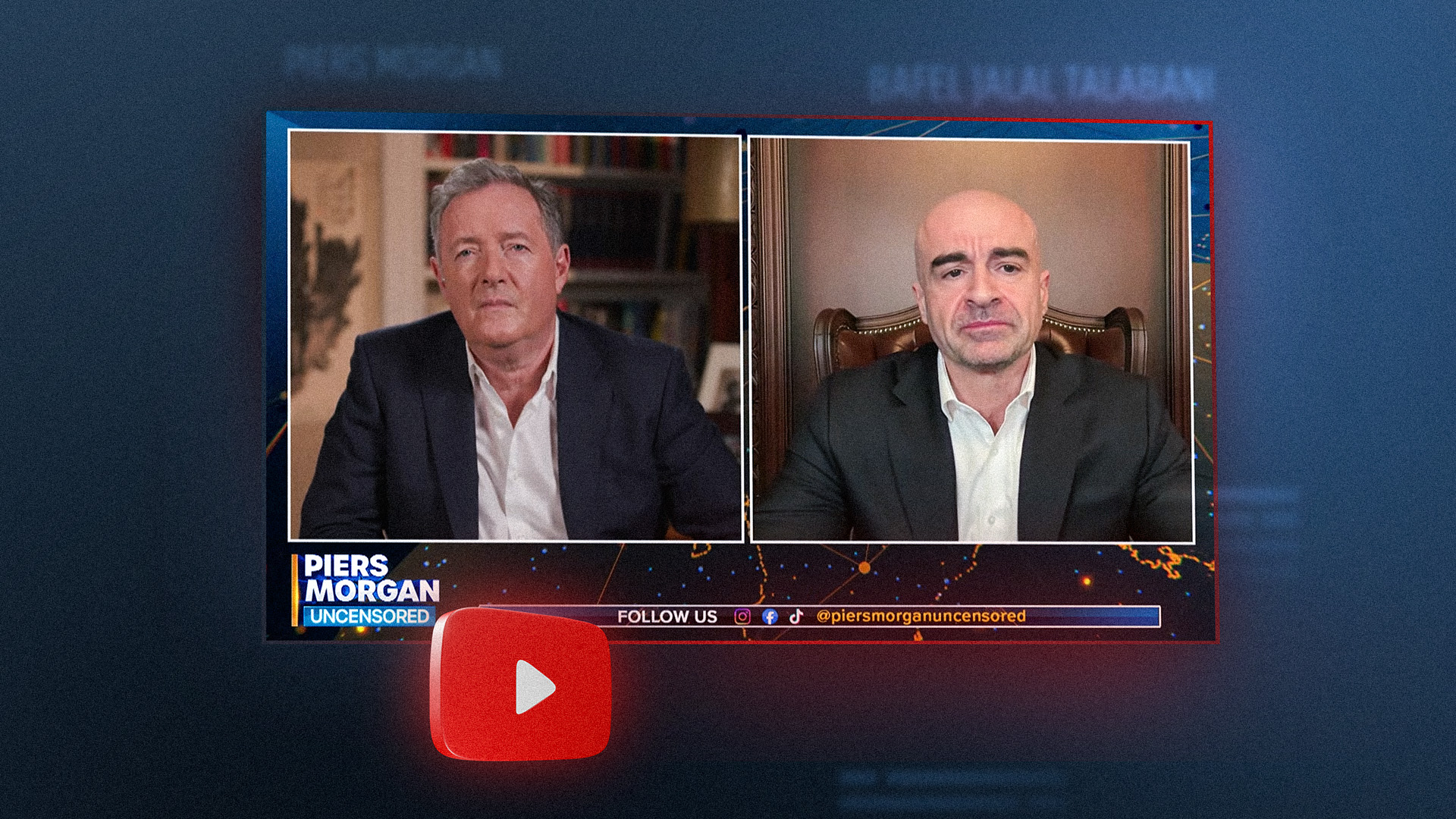
PUK President Bafel Jalal Talabani used an appearance on Piers Morgan Uncensored to reject claims of Kurdish involvement in weapons diversion and to argue that military action against Iran risks strengthening, rather than weakening, the state.
Bafel Jalal Talabani, President of the Patriotic Union of Kurdistan, responded to remarks made by United States President Donald Trump regarding the alleged diversion of weapons by Kurdish forces, saying that if the claims are true, the conduct described would be "absolutely shameful."
Talabani did not directly address the accuracy of Trump’s claim, but said that if such actions occurred, they would be “absolutely shameful.”
"I'm sure those words didn't come out of nowhere," he said, adding: "It's one thing to think that tactic of using the Kurds as the bulwark of the assaults was a bad idea, but it's a completely other thing to steal from your allies."
He described the political and administrative landscape in the Kurdistan Region as complex, calling it “a tale of two cities… we’re kind of a country, but not a country,” and noting that governance structures differ across areas, adding he could not speak for actions beyond his knowledge.
“You Can’t Bomb People Into Loving You”
Talabani offered a direct critique of military escalation in Iran, arguing that airstrikes risk producing unintended and counterproductive outcomes.
“You can’t bomb people into loving you,” he said, adding: “I just don’t believe it… I think the tactic is wrong, and it’s having the adverse effect.”
He said, based on accounts from contacts inside Iran, that strikes affecting civilian infrastructure can shift public sentiment. “Every time a school is destroyed, every time a university is destroyed, every time a hospital is destroyed… that’s not helpful,” he said.
Such actions, he argued, can unify populations: “We’ve seen people… who were demonstrating against the regime… now saying, ‘We’re not demonstrating for the regime… we’re demonstrating for our country.’”
Skeptical of Regime Change Through Force
Addressing the prospect of regime change in Iran, Talabani dismissed the idea that military action alone could bring about such an outcome.
“Honestly, I don’t believe so,” he said, arguing that external pressure tends to produce a rallying effect.
“If we were bombed… however unpopular the government… you would see people rally behind the country. It’s an instinctive human reaction,” he added.
He said such pressure can trigger a rally-around-the-flag effect, uniting populations behind the state.
Calls for a Broader Regional Settlement
Talabani urged U.S. policymakers to pursue a wider diplomatic framework that addresses interconnected conflicts across the Middle East.
“I think instead of a small win, there could be the opportunity for a larger win,” he said. “If they concentrated… not just this immediate conflict, but all the things… that exacerbate this conflict.”
He pointed to the potential for agreements extending beyond Iran, including the Palestinian issue and developments in Lebanon.
“If they went for a bigger deal… it would take more time. But the victory would be colossal… it would be a real win,” he said.
Backs Continued Talks and Mediation Efforts
Despite the collapse of recent negotiations, Talabani expressed cautious optimism about diplomacy.
“I’m optimistic… that the Pakistanis are sending a team to Tehran very soon to continue the negotiations,” he said.
He added that progress had been made during previous talks: “There was progress made… on many of the smaller issues… I’ve heard this from both sides.” Talabani also suggested that ceasefire arrangements could be extended to allow diplomacy to continue. “This ceasefire deadline isn’t written in stone… it’s very easy to extend things,” he said.
Warning Against Escalation
Throughout the interview, Talabani emphasized that military escalation is unlikely to resolve the conflict.
“This is one of those conflicts that violence will not resolve,” he said. “My hope is that people will see sense.”
He also cautioned against overreliance on diaspora perspectives in shaping policy, suggesting decision-makers should instead draw on direct intelligence and regional partnerships. “They may not be the right people to listen to,” he said.
16/04/2026