Erdogan Seeks Wider Membership for Regional Defense Pact
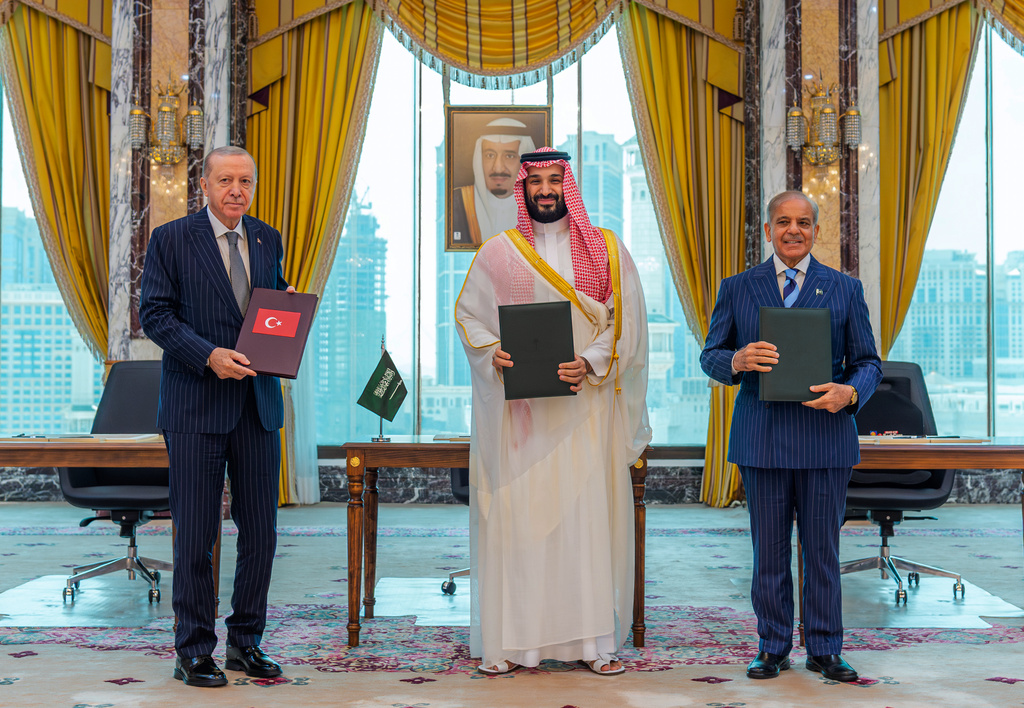
At a Glance
- Turkey seeks broader regional membership
- Egypt could join the pact
- Agreement includes a mutual defense clause
- Ankara and Riyadh deepen ties
Turkey is seeking to expand a new regional defense agreement with Saudi Arabia and Pakistan, as Ankara pushes for greater regional responsibility over security and stability.
Key Statements and Focus Area
- Recep Tayyip Erdogan: “Our vision for it is not limited to the three countries.
- Erdogan: "Regional issues should be resolved by regional actors.”
- Hakan Fidan: Turkey expects Egypt to join at a later stage.
Turkish President Recep Tayyip Erdogan said on Wednesday that he hopes additional countries will eventually join the defense agreement signed last week by Turkey, Saudi Arabia, and Pakistan.
Speaking to the London-based al-Sharq al-Awsat, Erdogan said the agreement was designed with a broader regional vision rather than being limited to its three founding members.
He said conditions could eventually allow countries across the region to come under the agreement’s framework.
Turkey’s Foreign Minister Hakan Fidan said on Saturday that Ankara expects Egypt to join the agreement at a later stage.
Fidan told Turkey’s state-run Anadolu news agency that only “a few technical issues” remained before Egypt could participate.
Egypt has not publicly commented on the agreement or Fidan’s remarks. Fidan is scheduled to visit Cairo on Thursday and Friday.
Turkey and Egypt maintain substantial military cooperation, although Cairo has not indicated that it intends to formally join the new security arrangement.
The agreement includes a NATO-style provision under which an attack against one member would be treated as an attack against all members.
The pact was signed as the Middle East faces the wider consequences of the five-month US-Iran war, including disruptions to shipping through the Strait of Hormuz and the Red Sea.
Erdogan said the agreement emerged from what he described as “new circumstances” in the region, with regional states seeking to assume greater responsibility for their own security.
Erdogan argued that regional disputes should be addressed by countries in the region rather than through externally imposed arrangements.
He described the agreement as a first step toward that approach and said the three countries also want to strengthen security cooperation and develop joint defense-industry projects.
The arrangement brings together three major US allies in an effort to establish a regional security framework independent of Israeli dominance, according to Erdogan.
Relations between Ankara and Riyadh have strengthened since the start of the war, following a period of strained ties between the two countries.
Erdogan said Turkey and Saudi Arabia would take further steps to raise bilateral relations “to much higher levels," without providing details on the planned measures.
FYI
The Mecca Joint Defense Agreement was formally ratified on August 7, 2026, bringing Turkey, Saudi Arabia, and Pakistan into a new collective security framework. Signed at al-Safa Palace by Saudi Crown Prince Mohammed bin Salman, Turkish President Recep Tayyip Erdogan, and Pakistani Prime Minister Shehbaz Sharif, the agreement establishes a collective-defence clause under which an armed attack on one signatory is treated as an attack on all.
The pact also establishes joint administrative mechanisms for cooperation on training, intelligence, and crisis management, reflecting a broader push by regional powers to develop security arrangements with greater regional ownership.
Dive Deeper: Handpicked Stories for You
Follow Channel8 for continuous updates:
Fidan Compares Mecca Pact to NATO Article 5 Collective Defense
Pezeshkian Meets Iran's Supreme Leader to Discuss National Economy
Lebanon Becomes First Middle Eastern Country to Abolish Death Penalty
2 hours ago