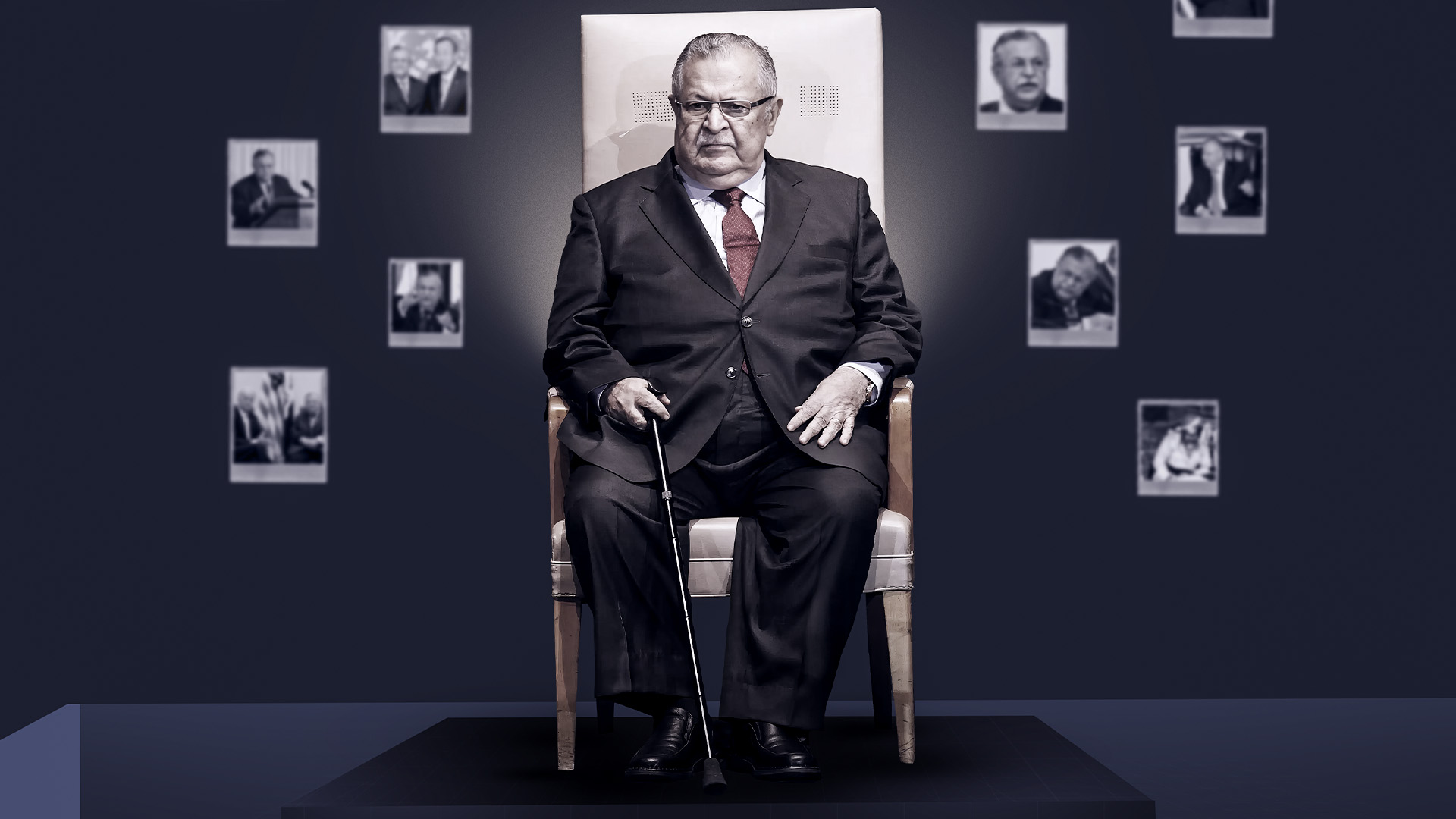
Channel8 Special: Mam Jalal Remembered as Iraq's Ultimate Unifying Figure
At a Glance
- Top Iraqi political figures praised the late President Mam Jalal (Jalal Talabani) for his historic role as Iraq's ultimate peacemaker.
- Referred to by the Shia Marjaeyat as Iraq's "safety valve" (Samam Aman), he was renowned for bridging deep sectarian divides and resolving Erbil-Baghdad disputes.
- Former and current leaders, including Ibrahim Bahr al-Ulum, Adil Abdul-Mahdi, and Qassim al-Araji, highlighted his magnanimity, non-retaliatory leadership, and crisis management.
- Interviewees emphasized that his legacy of dialogue and tolerance remains deeply missed in contemporary Iraqi politics.
Years after his passing, the political legacy of former Iraqi President Mam Jalal continues to be invoked as a masterclass in consensus-building and conflict resolution across Iraq's fractured political landscape.
Key Tributes and Historical Insights
- The Ultimate Mediator: Ibrahim Bahr al-Ulum told Channel8 that Mam Jalal functioned as a protective elder statesman and "problem solver" (Halal Mashakil), smoothing over tense negotiations during monumental crises such as the drafting of the 2005 constitution and the aftermath of the Samarra shrine bombing.
- Intra-Kurdish Reconciliation: Former Prime Minister Adil Abdul-Mahdi recalled Mam Jalal's pivotal role in bridging historical divides between the PUK and KDP, noting that his personal credibility provided a trusted mechanism to defuse regional shocks.
- Grace in Power: Former National Security Advisor Qassim al-Araji praised Mam Jalal's transition from opposition leader to head of state without harboring a spirit of retribution, describing his administration as rooted in paternal care and openness.
"He was like a brother and a father"
Ibrahim Mohammed Bahr al-Ulum, Head of the Bahr al-Ulum Foundation, told Channel8 in praise and discussion of Mam Jalal [Jalal Talabani]: "Mam Jalal did not just solve problems and crises; rather, he would calm the atmosphere within meetings and political friction."
Ibrahim Mohammed Bahr al-Ulum, who himself witnessed the days when Mam Jalal practiced politics wisely, stated: "He possessed a personality that sought to bring conflicting parties together. Iraq's problems and complexities were very severe—those problems had accumulated over decades, making their resolution extremely difficult. However, Mam Jalal's personality and charisma, acting like an elder brother and a father in politics, served as an umbrella to unite all factions. Consequently, all sides respected him and listened to him."
Mentioning Mam Jalal's humility, he pointed out that Mam Jalal would gather everyone in his reception room (diwan), and if they did not come, he would rise and go to them to resolve the disputes. This was ingrained in Mam Jalal's blood and character; in the Iraqi vernacular, he was referred to as (Halal Mashakil), meaning the "solver of problems."
Ibrahim Mohammed Bahr al-Ulum brought up examples of several crises and challenges that Mam Jalal resolved, such as the constitutional crisis in 2005, followed by the bombing of the al-Askari Shrine in Samarra, the 2010 political crisis, and numerous other crises, noting: "We would always resort to Mam Jalal for help."
Adel Abdul Mahdi: Mam Jalal took the initiative
Inside the Kurdistan Region, Mam Jalal continuously extended a hand of reconciliation to other parties, especially the Kurdistan Democratic Party (KDP). Adel Abdul Mahdi, a longtime friend of Mam Jalal and former Prime Minister of Iraq, described the resolution of disputes between the Patriotic Union of Kurdistan (PUK) and the KDP following the liberation of Iraq in the following manner:
He told Channel8: "I remember some remarks made by leaders from our brothers in the Kurdistan Democratic Party. As is known, there were historical disputes between the two parties. Following the passing of Mam Jalal, they lost that trusted channel. The Kurdistan Region has faced major shocks on multiple occasions, but Mam Jalal would always take the initiative."
He pointed out: "I remember once, in Paris, Kak Masoud [Barzani] and I met with Mam Jalal. At that time, the 49-to-51 agreement was made, under which it was agreed that Mam Jalal would assume responsibility in Baghdad while Kak Masoud would be responsible in the Kurdistan Region. I said to Mam Jalal, 'This is a tremendous act of courage on your part.'"
Mam Jalal did not seek revenge
Qasim al-Araji, the former National Security Advisor to the Prime Minister of Iraq, speaking about Mam Jalal, said that Mam Jalal went from leading a party opposed to the former regime to holding the presidency of the republic, yet he never sought revenge against anyone.
Al-Araji told Channel8: "There are numerous stories regarding Mam Jalal and his pursuit of reconciliation with all factions. He was first at peace with himself, to the extent that when he was at the pinnacle of power, he did not act with a retaliatory mentality. On the contrary, he behaved like a father, with an open hand for everyone."
Al-Araji, who is currently an influential figure in the political process, added: "Indeed, Mam Jalal painted a very beautiful picture and taught us a meaningful lesson on how one should conduct themselves when transitioning from the opposition to the pinnacle of power."
FYI
Mam Jalal (Jalal Talabani) served as the President of Iraq from 2005 to 2014, becoming the first non-Arab president of the country and a central pillar in post-2003 federal institution-building.
1 hour ago