North Korea Tests Hypersonic Missile Amid Regional Tensions
At a Glance
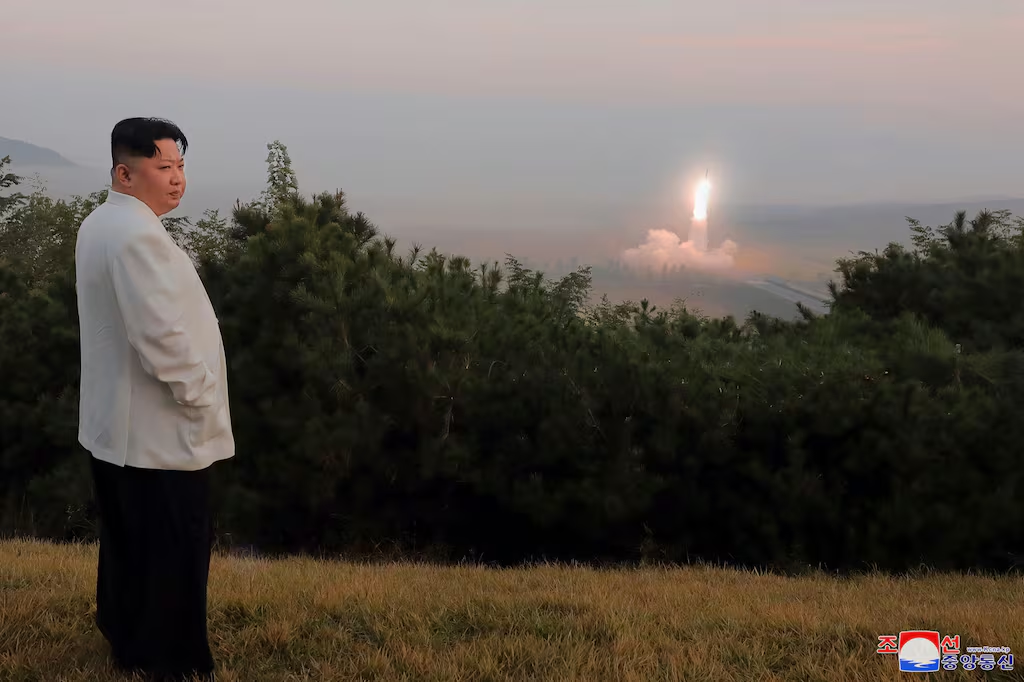
- North Korea says it conducted an intermediate-range strategic missile drill on October 3 under Kim Jong Un’s supervision.
- State media claims the missile is part of a hypersonic strategic weapons system and traveled about 1,000 kilometers.
- Kim Yo Jong says the missile can use artificial intelligence to alter its flight path at low altitude.
- South Korea reported detecting a ballistic missile that flew more than 700 kilometers toward the East Sea.
North Korea says leader Kim Jong Un oversaw the launch of an intermediate-range strategic missile as part of a drill involving a hypersonic weapons system.
Pyongyang described the test as an effort to strengthen its strategic deterrent, while South Korea, the United States and Japan reaffirmed that North Korean ballistic missile launches violate UN Security Council resolutions.
Key Statements
“This is a form of exercising deterrent.”
— Kim Jong Un, according to North Korean state media.
“We must continue our responsible efforts nonstop to constantly and repeatedly make the enemy recognize the reliability and fatality of our strategic offensive means.”
— Kim Jong Un, according to KCNA.
“There is no way to avoid” an attack by the missile.
— Kim Yo Jong, referring to North Korea’s claimed AI-assisted maneuverability.
Hypersonic Capability
North Korea says the missile was used to train personnel operating its hypersonic strategic weapons system and to evaluate the system’s reliability, efficiency and maneuverability.
KCNA said the missile struck a target approximately 1,000 kilometers away in waters off North Korea’s eastern coast. South Korea’s military, however, initially reported that it detected a ballistic missile traveling more than 700 kilometers from the Wonsan area.
AI Maneuverability Claim
Kim Yo Jong claimed the missile was capable of changing its trajectory at low altitude using artificial intelligence.
She also criticized South Korean and Japanese tracking assessments, arguing that the missile’s maneuvering flight profile exposed limitations in their ability to track it.
Those claims have not been independently established. South Korea has maintained that its surveillance systems accurately detected and tracked the launch.
Regional Response
Japan, the United States and South Korea held a trilateral foreign-ministry call following the launch. They reaffirmed that North Korean ballistic missile launches violate relevant UN Security Council resolutions and called on Pyongyang to stop actions that threaten regional and international security.
Japan’s prime minister’s office separately ordered authorities to maximize intelligence gathering, protect aircraft and vessels, and prepare for contingencies.
FYI
The launch comes amid a broader deterioration in inter-Korean relations. Tensions have risen following a landmine explosion in the Demilitarized Zone that injured South Korean soldiers, with Seoul accusing Pyongyang of responsibility and North Korea rejecting the accusation.
The missile test also follows a series of North Korean weapons demonstrations this year, including earlier tests of systems Pyongyang has described as hypersonic. The latest launch is significant because North Korea is presenting the system not simply as a missile test, but as part of its strategic and nuclear deterrence architecture. Analysts will be watching whether the claimed maneuverability and hypersonic characteristics translate into an operational capability capable of complicating regional missile defenses.
Importantly, North Korea’s claims about AI guidance, a 1,000-kilometer flight and near-immunity from interception should not be presented as independently verified capabilities. South Korean authorities reported a shorter flight distance and disputed Pyongyang’s characterization of tracking limitations.
Dive Deeper: Handpicked Stories for You
Follow Channel8 for continuous updates:
59 minutes ago