Japan Launches Mission to Retrieve Samples From Mars Moon
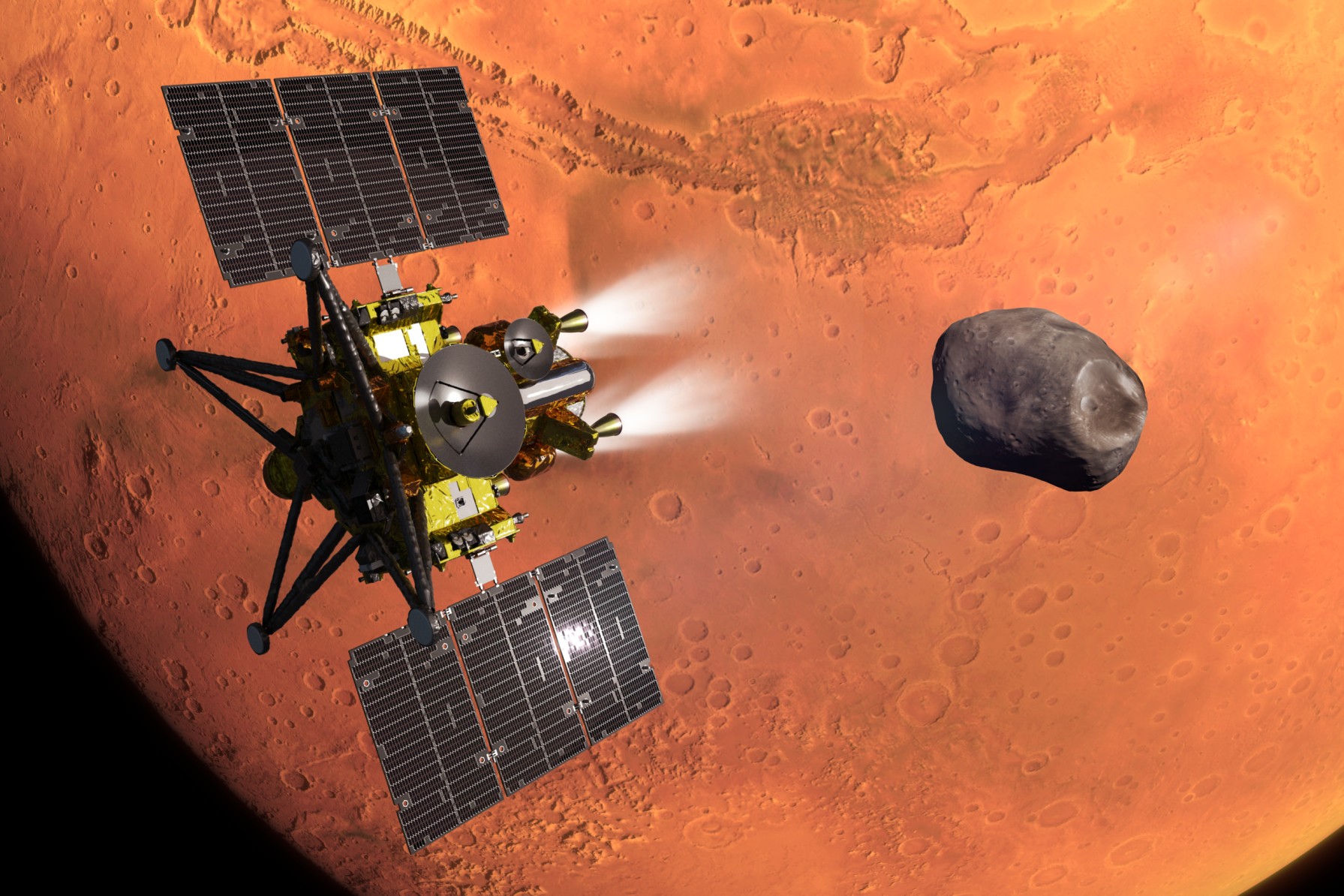
At a Glance
- Japan has launched a mission to collect samples from Phobos, one of Mars’ two moons.
- The five-year mission aims to return at least 10 grams of material to Earth in 2031.
- Scientists hope the samples will reveal how Mars’ moons formed and provide clues about the planet’s history.
- The mission includes international contributions from NASA and European space agencies.
Japan’s space agency has launched a mission to collect and return samples from Phobos, one of Mars’ two moons, in an effort to uncover how the celestial bodies formed and better understand the Red Planet’s history.
Key Statements and Focus Area
- Yasuhiro Kawakatsu, MMX project manager: "The samples could help scientists assess the potential use of a Martian moon as a base for future crewed missions to Mars."
- Kiyoshi Kuramoto, MMX principal investigator: "Scientists expect analysis of Phobos soil samples to help resolve questions about the moon’s origins."
- International cooperation: The mission includes instruments and technical support from NASA and European space agencies, alongside Japanese equipment.
Scientists Seek Answers About Mars’ Moons
The Japan Aerospace Exploration Agency’s Martian Moons eXploration mission was launched aboard Japan’s H-3 rocket. It aims to investigate Phobos and Deimos, two irregular, cratered moons whose origins remain uncertain despite decades of Mars exploration.
Scientists have proposed two main explanations for their formation. One theory suggests the moons formed from debris after a large object struck Mars. Another holds that they may be asteroids captured by the planet’s gravity.
JAXA officials expect samples from Phobos to help distinguish between these possibilities. Scientists selected Phobos because it orbits closer to Mars than Deimos and may contain more material originating from the planet.
According to JAXA, material from Mars is expected to account for about 0.1% of the collected samples. Researchers hope that studying this material could provide additional evidence about the planet’s history, including the conditions that may have been relevant to the emergence of life.
The mission will also fly by Deimos to gather observations that could help scientists understand the relationship between the two moons.
Three Years of Observations Around Phobos
The spacecraft is expected to reach the Mars region around August 2027, following a journey of approximately 500 million to 600 million kilometers. It will then spend about three years studying Phobos and preparing to collect samples.
The spacecraft weighs around five tonnes and consists of propulsion, exploration, and sample-return modules. Only the return module is designed to travel back to Earth, carrying the collected material in a protected capsule.
The mission carries 13 instruments, including a rover developed jointly by France and Germany, a NASA sampling device, and a European deep-space communications instrument. Japanese equipment will also measure radiation to support research relevant to future crewed Mars missions.
Rover Will Prepare the Way for Sampling
The French-German rover, named Idefix, is scheduled to land on Phobos ahead of the main spacecraft. During a planned 100-day mission around 2029, it will explore the surface and help scientists identify suitable areas for sample collection.
JAXA aims to collect at least 10 grams of material through two sampling attempts. One method, developed by NASA, uses pressurized gas to lift surface dust into a container. The Japanese method will collect material from about two centimeters below the surface.
The mission plans to gather surface and underground material during its first sampling operation, followed by additional underground sampling during a second landing.
Collecting material from different depths and locations could help researchers examine the moon’s composition and search for possible traces of past microbial life originating from Mars. However, the mission is not itself a confirmation that life existed on the planet.
The samples will be stored in a heat-protected capsule designed to withstand re-entry into Earth’s atmosphere. The capsule is expected to land in Australia before the material is transported to Japan for analysis.
Landing Presents Technical Challenges
Phobos has extremely weak gravity, estimated at around one-two-thousandth of Earth’s, making landing and surface operations difficult.
The spacecraft must identify a relatively smooth, level landing site using topographical information collected by the rover. After touchdown, it will have a limited window of about two hours to complete its sampling operation.
To reduce the risk of bouncing on the surface, the exploration module has four shock-absorbing landing legs. The rover is also designed to maintain traction in low gravity, recover if it tips over, and move slowly across the uneven terrain.
Japan has previously returned samples from asteroids through its Hayabusa missions, which brought material back to Earth in 2010 and 2020. The MMX mission extends that experience to the moons of another planet.
FYI
Phobos and Deimos are Mars’ two small moons, named after figures associated with fear and terror in Greek mythology. Phobos is the larger of the pair and orbits Mars at a distance of roughly 6,000 kilometres, completing about three orbits around the planet each day.
Returning samples to Earth allows scientists to use laboratory instruments that are more advanced and precise than those that can be carried aboard spacecraft. Analysis of material from Phobos could help researchers investigate the moon’s composition, its relationship to Mars, and the history of the Martian system.
Dive Deeper: Handpicked Stories for You
Follow Channel8 for continuous updates:
Scientists Challenge Claim Nuclear Blast Destroyed Ancient Martian Civilization
3 hours ago