Pezeshkian Conditions Hormuz Access on Lifting All US Sanctions
At a Glance:
- Iranian President Masoud Pezeshkian confirmed an agreement with Oman on a passage route, making waterway access conditional on U.S. compliance with the Islamabad Memorandum.
- Tehran demands the lifting of U.S. sanctions on its oil and petrochemical sectors, the release of frozen foreign assets, and investment guarantees.
- The Islamic Revolutionary Guard Corps (IRGC) reaffirmed complete operational control over the strait, dismissing U.S. claims of open navigation.
- Pezeshkian will meet Russian President Vladimir Putin on September 1 at the Shanghai Cooperation Organisation (SCO) summit in Bishkek, Kyrgyzstan.
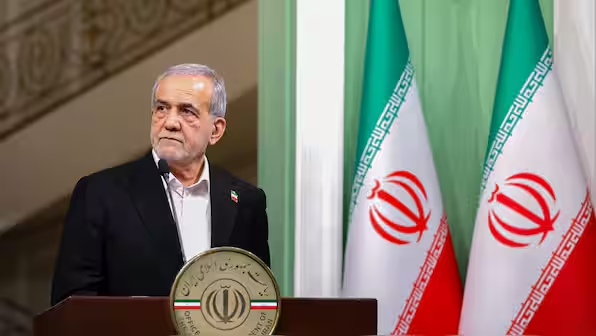
Iranian President Masoud Pezeshkian announced an agreement with Oman regarding a managed transit route through the Strait of Hormuz, explicitly tying the reopening of the strategic waterway to U.S. compliance with earlier diplomatic commitments. Addressing national media, Pezeshkian stated that Tehran would restore maritime access if Washington lifts targeted economic sanctions, releases blocked assets, and supports regional stabilization efforts.
Key Statements:
"We agreed with Oman on the passage route through Hormuz, and if the U.S. fulfills its commitments under the memorandum of understanding, we will open the strait." — Masoud Pezeshkian, Iranian President.
"If the U.S. fulfills its commitments regarding lifting the sanctions and blockade, releasing assets, beginning investment, and ending the war in Lebanon, we will also open the Strait of Hormuz." — Masoud Pezeshkian, Iranian President.
Omani Mediation and Conditions for Transit
Following negotiations facilitated by Muscat, Tehran established a framework for managing vessel movement through Omani and Iranian territorial waters. Pezeshkian noted that Iran's Supreme National Security Council reached consensus on the route proposals, which have been submitted to Supreme Leader Ali Khamenei for final approval. However, Iranian officials emphasized that functional access relies on the U.S. honoring the terms of the Islamabad Memorandum signed in June, including the complete removal of banking and energy sanctions.
IRGC Authority and Eurasian Diplomacy
Concurrently, the IRGC rejected White House assertions regarding unrestricted navigation, declaring that all maritime transit remains under direct Iranian oversight. Facing domestic wartime energy pressures and reduced trade volumes, Pezeshkian is expanding diplomatic outreach. He is scheduled to hold a high-level bilateral meeting with Russian President Vladimir Putin on September 1 on the sidelines of the SCO summit in Kyrgyzstan to strengthen economic ties and discuss Middle Eastern regional security.
FYI
By linking freedom of navigation in the Strait of Hormuz to concrete economic concessions and military de-escalation, Tehran is using its geographic position as leverage against Washington. Pezeshkian's engagement with regional partners like Oman and major powers like Russia underscores Iran's strategy to offset domestic financial strains while forcing a return to negotiated agreements.
Dive Deeper: Handpicked Stories for You
Follow Channel8 for continuous updates:
US Treasury to Cut Off Banque Misr UAE Over Iran Ties
US Signals Pivot From Direct Military Strikes to Economic Pressure on Iran
34 minutes ago