Three US Aircraft Carriers Expected In Middle East Soon
At a Glance
- The United States is expected to have three aircraft carriers operating in or heading toward the Middle East in the coming weeks.
- The USS George Washington and USS George H.W. Bush are already operating in the region, while the USS Theodore Roosevelt has departed San Diego for a Middle East deployment.
- Two Amphibious Ready Groups, carrying Marine Expeditionary Units, are also expected to operate in the region.
- The temporary overlap would give Washington a significantly larger concentration of naval aviation, missile-defense, strike and crisis-response capabilities amid continued tensions with Iran.
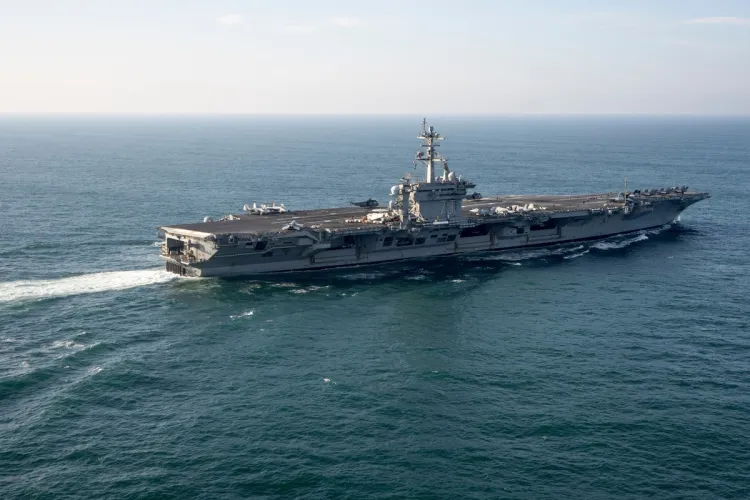
The United States is preparing for an unusually large concentration of naval power in the Middle East, with three aircraft carriers and two Marine Expeditionary Units expected to be operating in or moving toward the region as scheduled rotations overlap.
The buildup is being driven partly by routine force rotations, with incoming ships arriving before some existing forces depart. The resulting overlap would temporarily place three carrier strike groups and two amphibious formations in the broader U.S. Central Command area of operations.
The Three-Carrier Presence
The three carriers involved are the USS George Washington, USS George H.W. Bush and USS Theodore Roosevelt.
The George Washington entered the U.S. 5th Fleet area in August and is currently operating in the region. The George H.W. Bush is also operating in the Arabian Sea in support of U.S. military operations in the Middle East.
The Theodore Roosevelt departed San Diego on September 27 for an extended deployment. U.S. defense officials told USNI News that the carrier is expected to move to the U.S. Central Command area and eventually relieve the George Washington.
The planned relief creates the possibility of a period in which the outgoing and incoming carrier strike groups are simultaneously present, leaving Washington with three carrier strike groups in the region.
That would represent a substantial concentration of naval aviation assets, even though the buildup is expected to be temporary.
What The Carriers Bring
Aircraft carriers provide mobile airpower that can operate without relying exclusively on regional land bases.
Each carrier strike group includes the carrier, its embarked air wing and a collection of surface ships and other supporting assets. Together, those forces provide capabilities ranging from air defense and surveillance to long-range strike and maritime security.
The additional carrier presence would therefore increase the number of aircraft available to U.S. commanders while expanding the ability to protect American forces and partners and respond rapidly to developments across the region.
The concentration also provides flexibility during a period of heightened tensions involving Iran and continued instability in several parts of the Middle East.
Two Amphibious Ready Groups
The naval buildup extends beyond the carriers.
The USS Boxer Amphibious Ready Group, carrying the 11th Marine Expeditionary Unit, is already operating in the Arabian Sea. The formation includes the USS Boxer, USS Comstock and USS Portland. USNI News reported that the group remained in the Arabian Sea at the end of September.
The Makin Island Amphibious Ready Group, carrying the 13th Marine Expeditionary Unit, departed San Diego on September 28.
The group consists of the USS Makin Island, USS Anchorage and USS John P. Murtha. A U.S. Navy official confirmed the deployment, while the 13th Marine Expeditionary Unit is accompanying the ships.
An ARG/MEU provides a combination of naval, aviation, ground and logistical capabilities. USNI News says a typical MEU includes about 2,200 Marines and sailors, while the three amphibious ships carry additional sailors.
Marine Expeditionary Capabilities
The 13th MEU brings a Marine Air-Ground Task Force that includes infantry, logistics and aviation components.
Its aviation element includes MV-22B Ospreys, AH-1Z Viper attack helicopters and F-35B Lightning II aircraft, according to Marine Corps information cited by USNI News.
The amphibious configuration gives commanders capabilities that differ from those provided by an aircraft carrier.
The ships can transport Marines, helicopters, tiltrotor aircraft, vehicles and equipment, allowing the force to conduct amphibious operations, evacuations, humanitarian missions, crisis-response operations and other contingencies.
The combination of carrier strike groups and amphibious forces therefore gives the United States a broad range of options without requiring all forces to operate from fixed bases on land.
Why The Concentration Matters
The significance of the buildup is not simply the number of ships.
Three carrier strike groups would provide a larger pool of combat aircraft and supporting capabilities, while the two Marine formations would add aviation, ground combat and expeditionary response forces.
Together, the forces could support several missions, including:
- Conducting or supporting air operations.
- Protecting U.S. military personnel and facilities.
- Providing air and missile-defense capabilities.
- Protecting commercial shipping and maritime routes.
- Conducting surveillance and reconnaissance.
- Responding to regional security emergencies.
- Evacuating civilians during a crisis.
- Moving Marines and equipment ashore if required.
The presence also offers Washington greater flexibility in responding to rapidly changing conditions without necessarily relying on additional land-based deployments.
Iran And Regional Tensions
The buildup comes against the backdrop of continuing U.S.-Iran tensions and an ongoing military confrontation.
U.S. Central Command describes Operation Epic Fury as a campaign targeting what it calls Iran’s security apparatus and locations posing an imminent threat.
At the same time, diplomatic efforts have continued, with regional governments involved in attempts to reduce tensions and address issues including the Strait of Hormuz and sanctions.
The concentration of U.S. naval forces therefore carries both operational and signaling implications.
From a military perspective, additional forces provide commanders with greater capacity and flexibility. From a strategic perspective, the deployment demonstrates that Washington is maintaining substantial military capabilities in the region while diplomatic efforts remain uncertain.
A Temporary Buildup
Despite the scale of the concentration, the buildup is not expected to represent a permanent increase in the U.S. naval presence.
The deployment of the Theodore Roosevelt is part of a planned rotation, with the carrier expected eventually to relieve the George Washington.
Similarly, the Makin Island ARG deployment is described as a scheduled deployment. Its eventual movement into the region would add to forces already there, including the Boxer ARG.
As individual rotations are completed and ships leave the region, the number of carriers and amphibious forces is expected to decline.
The unusual concentration is therefore largely the result of overlapping deployments rather than a permanent restructuring of the U.S. naval posture.
Strategic Significance
The temporary overlap nevertheless gives U.S. commanders an unusually broad set of capabilities at a time when maritime security, Iran-related tensions and threats to American personnel remain major concerns.
Aircraft carriers provide sustained airpower and air-defense capabilities, while amphibious formations provide mobile forces capable of responding to emergencies on land and at sea.
The deployment also underscores the continuing importance of the Middle East to U.S. military planning, despite Washington's broader efforts in recent years to balance resources across the Indo-Pacific, Europe and other theaters.
For regional governments and U.S. partners, the additional naval presence provides a visible indication of American military capacity. For potential adversaries, it increases the number of U.S. assets operating within reach of regional flashpoints.
FYI
The expected three-carrier, two-MEU concentration is significant because it combines several different forms of U.S. military power during a period of elevated regional tensions. The George Washington, George H.W. Bush and Theodore Roosevelt provide carrier-based airpower, while the Boxer and Makin Island amphibious groups add expeditionary Marine forces and additional aviation capabilities.
The buildup should nevertheless be viewed in the context of scheduled rotations. The Theodore Roosevelt is expected to eventually replace the George Washington, meaning the three-carrier overlap is temporary rather than evidence by itself of a permanent expansion of U.S. naval forces in the region.
Its immediate significance is therefore the additional military capacity available during the overlap. That capacity includes air operations, maritime security, force protection, crisis response and potential evacuation or expeditionary missions. The deployment also sends a visible signal of U.S. military readiness while tensions with Iran remain high and diplomatic efforts continue.
Dive Deeper: Handpicked Stories for You
Follow Channel8 for continuous updates:
US Expands Iran Sanctions To Automakers, Rail And Metals Sectors
UK PM Says “Strong Indications” Iran Played Part In RAF Fairford Incident
Russia Urges Iran To Remain In Nuclear Non-Proliferation Treaty
1 hour ago