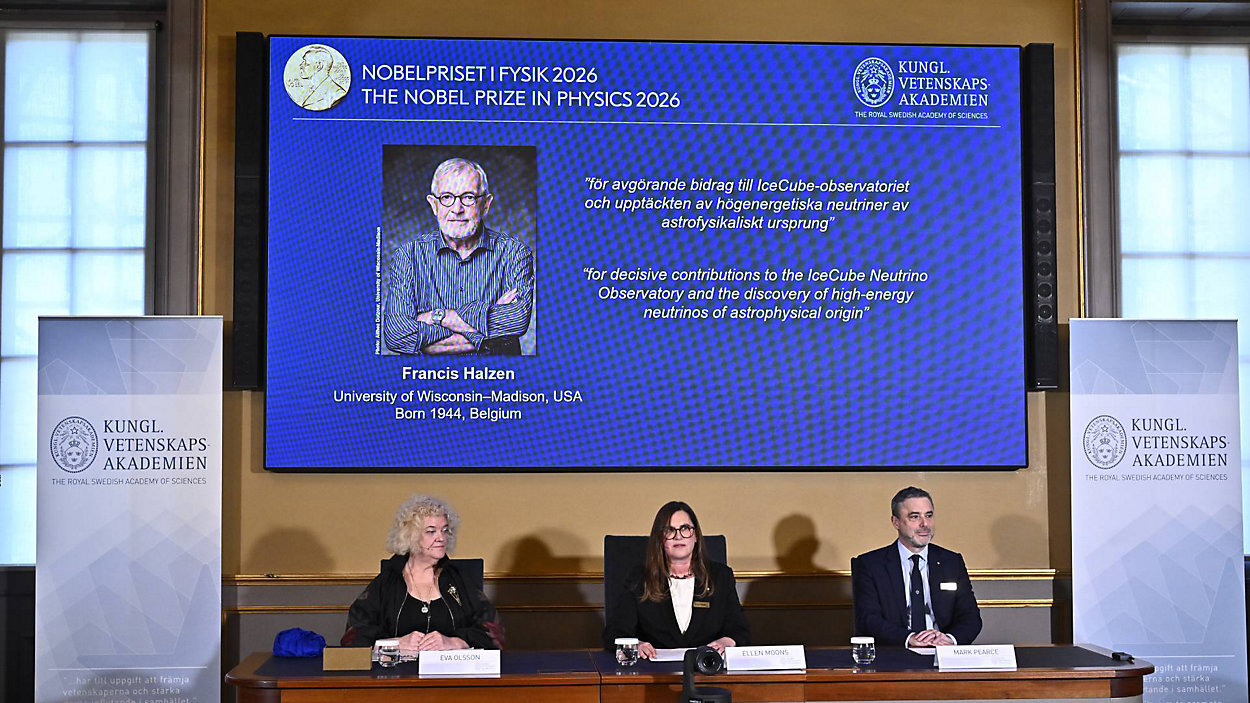
Francis Halzen Wins 2026 Nobel Prize in Physics
At a Glance
- Belgian-born scientist Francis Halzen has won the 2026 Nobel Prize in Physics.
- His work helped establish neutrino astronomy through the IceCube observatory in Antarctica.
- The prize recognizes research into high-energy neutrinos and the evolution of the universe.
Belgian-born scientist Francis Halzen has won the 2026 Nobel Prize in Physics for pioneering work on high-energy neutrinos, opening a new way to study the universe.
Key Statements and Focus Area
- Award: “It was a great surprise, and I obviously didn’t expect it.” — Francis Halzen
- Research: “This experiment in the Antarctic is a revolutionary way of understanding the universe that we didn’t have before.” — Michael Moloney, American Institute of Physics
- Focus Area: Halzen’s research helped establish neutrino astronomy and provided new ways to study the origins and evolution of the universe.
Halzen, 82, was announced as the physics laureate by the Royal Swedish Academy of Sciences in Stockholm on Tuesday.
Speaking by phone during the announcement, Halzen said he hoped the award would help secure approval for a research proposal he is currently working on.
His work was instrumental in developing the IceCube Neutrino Observatory at the South Pole, which uses Antarctic ice to detect high-energy neutrinos arriving from distant parts of the universe.
Neutrinos have no electrical charge and an extremely small mass. They are produced by sources including stars and pass through matter constantly, but their weak interactions make them exceptionally difficult to detect.
IceCube uses thousands of sensors buried about 2,500 meters beneath the Antarctic surface. When a neutrino interacts with the ice, it produces a flash of light that the sensors can record.
The observatory's detections of high-energy neutrinos from distant galaxies have helped scientists study cosmic events and investigate how the universe and galaxies developed.
Halzen is affiliated with the University of Wisconsin Madison, which operates the observatory. The Nobel Prize comes with 12 million Swedish kronor, worth about $1.2 million this year.
FYI
Halzen is the 11th Belgian Nobel laureate, according to Belgian Prime Minister Bart De Wever. His work has helped establish neutrinos as a tool for astronomy, allowing scientists to investigate the universe through particles that can travel vast distances without being significantly affected by matter.
The 2026 Nobel Prize announcements began with the medicine award on Monday. The chemistry prize and literature prize are due later this week, followed by the peace prize on Friday and the economics prize next Monday.
Dive Deeper: Handpicked Stories for You
Follow Channel8 for continuous updates:
2 hours ago