IMF Chief Urges Guardrails to Contain Artificial Intelligence Risks
At a Glance
- IMF Managing Director Kristalina Georgieva says AI development needs stronger safeguards.
- Anthropic policy chief Jack Clark warns that companies cannot regulate the technology alone.
- The IMF says AI could transform jobs, eliminate repetitive work, and create new service-sector roles.
- Experts warn that workers displaced by technological change need support to avoid growing inequality.
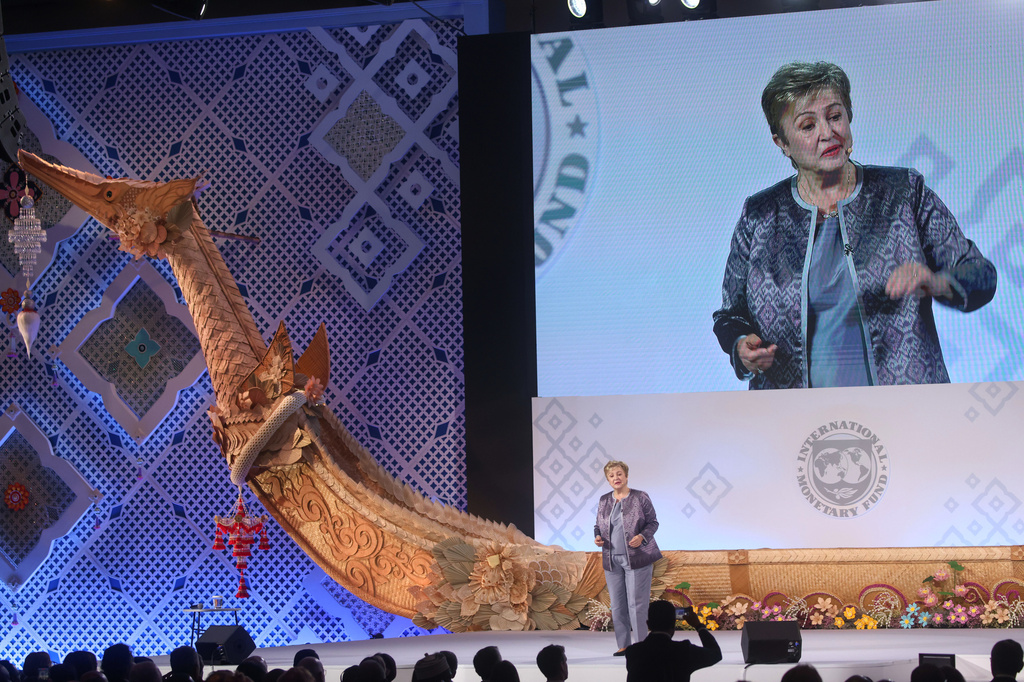
International Monetary Fund Managing Director Kristalina Georgieva has called for safeguards to manage the risks of rapid artificial intelligence development, warning that the technology’s potential benefits could be undermined if it causes harm.
Key Statements and Focus Area
- Kristalina Georgieva, IMF: "AI could bring major benefits, but safeguards are needed to prevent its risks from harming people."
- Jack Clark, Anthropic: "Companies should not make AI governance decisions alone, and governments and other institutions must help establish policy frameworks."
- Tiff Macklem, Bank of Canada: "Technological change can generate overall economic benefits while displacing workers, making support systems essential."
Calls grow for AI safeguards
Georgieva compared the rapid development of artificial intelligence to a Formula 1 race car that could leave the track and injure people, arguing that safeguards are urgently needed. “We are racing, and the question is how do we put barriers? So if a car was to fly out it doesn’t kill people,” she said during a panel discussion on AI’s impact on the global economy.
She praised the technology’s potential contribution to humanity but warned that its benefits could be outweighed by the consequences if risks are not controlled.
Jack Clark, Anthropic’s co-founder and head of policy, described the situation as more dangerous than a race without adequate safeguards. He argued that consumer products face stricter regulation than some advanced AI systems.
Clark has called for faster action on AI governance. In a blog post last month, Anthropic proposed that leading AI companies coordinate on a possible pause in the development of advanced systems, citing concerns about the pace of progress and the risk of humans losing control.
Clark said work on regulatory frameworks was already underway but stressed that decisions should not be left to technology companies alone. “The world is now taking this seriously, and I think if we take it seriously, we are going to be able to get our arms around it,” he said. “But it cannot only be companies making these decisions.”
AI's uncertain impact on jobs
Georgieva outlined three employment trends identified in an IMF study: jobs that could be transformed or newly created, repetitive work that could disappear, and service-sector employment generated by people benefiting from investment in AI.
She said about 10% of jobs might be transformed or newly created, while acknowledging that the overall employment effects remain uncertain.
Georgieva described the net impact as positive but warned that some workers could move into lower-paid service jobs rather than the professional roles they had expected to pursue. “The net impact is positive,” she said, adding that “services don’t pay a lot.” She said some young people who might otherwise have entered routine professional jobs could instead find themselves working in service roles.
Economists warn of winners and losers
Tiff Macklem, governor of the Bank of Canada, compared the potential effects of AI on employment with those of expanded international trade. Trade has generated substantial global wealth and helped lift millions of people out of poverty, he said, but it has also displaced workers as manufacturing jobs moved to China and other developing economies.
“In aggregate there is an overall benefit,” Macklem said, while acknowledging that both trade and technological change produce winners and losers.
“You have to find a way to help the losers,” he said, warning that a lack of support for displaced workers could trigger a backlash. The discussion took place amid wider concerns about inequality. Dozens of people marched peacefully in Bangkok on Thursday and Friday to draw attention to growing economic disparities and other grievances.
Access and cybersecurity remain concerns
Georgieva said the benefits of AI would depend partly on whether people had access to reliable electricity and digital networks. Cybersecurity would also be essential as the technology becomes more widely used.
The panel also discussed the speakers’ personal experiences with AI. Georgieva said she had used the technology to track calories and lose weight, while joking that AI assistants could be overly demanding.
“I mean, the agents we get, they can be really annoying,” she said. “So can we work on, like, their manners?” Clark responded that developers were adjusting the balance between AI systems that are overly agreeable and those that can be rude.
FYI
The International Monetary Fund monitors global economic and financial stability and advises governments on economic policy. Its research on artificial intelligence examines how the technology could affect productivity, employment, wages, and economic inequality across countries.
AI regulation remains an evolving policy area, with discussions spanning safety testing, accountability, cybersecurity, transparency, and the responsibilities of developers and governments. The potential effects on workers also depend on how quickly businesses adopt the technology and whether education, retraining, and social protection systems adapt.
Dive Deeper: Handpicked Stories for You
Follow Channel8 for continuous updates:
1 hour ago