China’s Economy Grows 4.5% as AI-Linked Exports Surge
At a Glance
- China’s economy grew 4.5% year-on-year in the third quarter of 2026, up from 4.3% in the previous quarter.
- Exports rose 16.4% in the first nine months, supported by demand for technology-related goods.
- September industrial production increased 5.5%, while retail sales grew 1.1%.
- Fixed-asset investment fell 7.2% in the first nine months, highlighting continued weakness in domestic investment.
China’s economy grew faster than expected in the third quarter of 2026, supported by strong exports and industrial output, although weak domestic demand and falling investment continue to weigh on the world’s second-largest economy.
Key Statements and Focus Areas
Economic Growth Accelerates
China’s gross domestic product expanded by 4.5% year-on-year between July and September, compared with 4.3% in the second quarter, according to the National Bureau of Statistics. Growth for the first nine months reached 4.6%.
The third-quarter figure exceeded the 4.4% growth forecast in a Reuters poll of economists.
Exports and Technology Demand
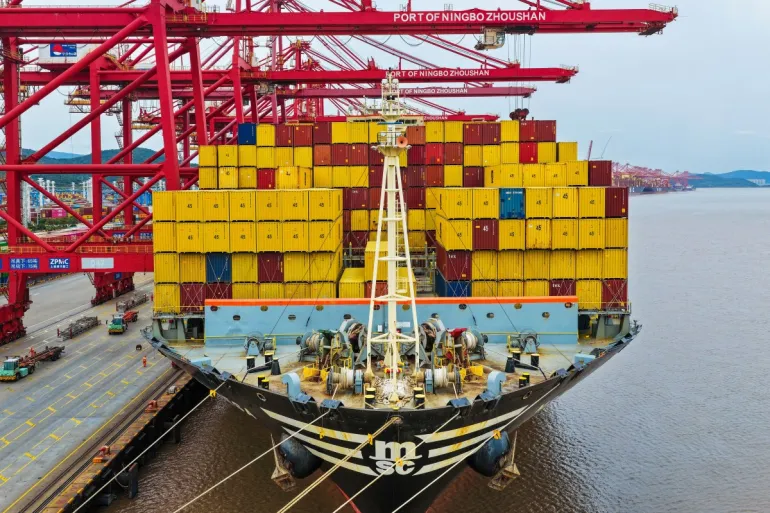
- China’s exports rose 16.4% year-on-year during January–September, reaching approximately 23.20 trillion yuan.
- Exports of mechanical and electrical products increased 23.7%, accounting for 64.3% of total exports.
- Demand for semiconductors and other technology-related goods has supported export growth amid the global artificial intelligence boom.
Domestic Demand Remains Weak
Retail sales increased 1.1% year-on-year in September, matching the growth rate recorded across the first nine months. Industrial production rose 5.5% in September, with growth for January–September reaching 5.3%.
Fixed-asset investment, which includes spending on factories, machinery and real estate, declined 7.2% during the first nine months compared with the same period in 2025.
Official Growth Target
China’s 2026 annual GDP growth target is 4.5% to 5%. The 4.6% expansion recorded during the first nine months places the economy within that range so far, although the full-year outcome remains uncertain.
China’s economy expanded by 4.5% year-on-year in the July–September quarter, accelerating from 4.3% growth in the previous quarter and exceeding analysts’ expectations, according to official figures released on Monday.
The National Bureau of Statistics said GDP grew 4.6% during the first three quarters of 2026. The economy also expanded 1.2% quarter-on-quarter in the July–September period.
Strong exports have helped sustain economic activity, particularly as global demand for semiconductors, electronics and other technology-related products grows alongside investment in artificial intelligence. China’s exports rose 16.4% year-on-year in the first nine months to approximately 23.20 trillion yuan, equivalent to about $3.47 trillion, according to official data. Exports of mechanical and electrical products increased 23.7% over the same period.
However, the export performance contrasts with weaker activity at home. Retail sales rose 1.1% in September, while industrial production increased 5.5%. For the first nine months, retail sales grew 1.1% and industrial production expanded 5.3%, according to the statistics bureau.
Investment remains a significant concern. Fixed-asset investment fell 7.2% between January and September, reflecting continued pressure on spending across areas including property, factories and infrastructure. The prolonged property-sector downturn has also weighed on confidence and domestic demand.
Economists have cautioned that stronger headline growth does not necessarily indicate a broad-based recovery. Zhiguo He, a finance professor at Stanford University’s Graduate School of Business who studies the Chinese economy, told Al Jazeera that Beijing would remain wary of its reliance on exports to sustain growth.
China’s ruling Communist Party has set a growth target of 4.5% to 5% for 2026. The latest figures put growth within that range for the first nine months, but sustaining momentum will depend in part on whether domestic consumption and investment strengthen alongside exports.
Data Table
| Indicator | Latest figure | Period |
|---|---|---|
| GDP growth | 4.5% | Q3 2026, year-on-year |
| GDP growth | 4.6% | January–September 2026 |
| Export growth | 16.4% | January–September |
| Industrial production growth | 5.5% | September |
| Retail-sales growth | 1.1% | September |
| Fixed-asset investment | Down 7.2% | January–September |
FYI
China’s latest figures illustrate the tension between its strength in manufacturing and exports and the challenge of generating stronger demand at home. Technology-related exports have helped lift growth, but subdued retail sales and falling fixed-asset investment suggest that momentum remains uneven across the economy.
The broader question for Beijing is whether export-led expansion can remain resilient amid trade tensions and shifting global demand, while domestic consumption and investment recover. Meeting the annual growth target would not, by itself, resolve the structural pressures reflected in the latest data.
Dive Deeper: Handpicked Stories for You
Follow Channel8 for continuous updates:
Body of Halabja Teacher Returned from China After Forty Days
2 hours ago