U.S. Business Delegation Explores Strategic Investment Opportunities in Slemani
At a Glance
- A high-level U.S. business delegation met with the Slemani Chamber of Commerce to examine multi-sector investments.
- Delegation head David Tafuri highlighted opportunities for leading U.S. firms to fill the void left by shifts in the American military posture.
- The officials prioritized natural gas development to position the Kurdistan Region as a primary Middle Eastern supply hub.
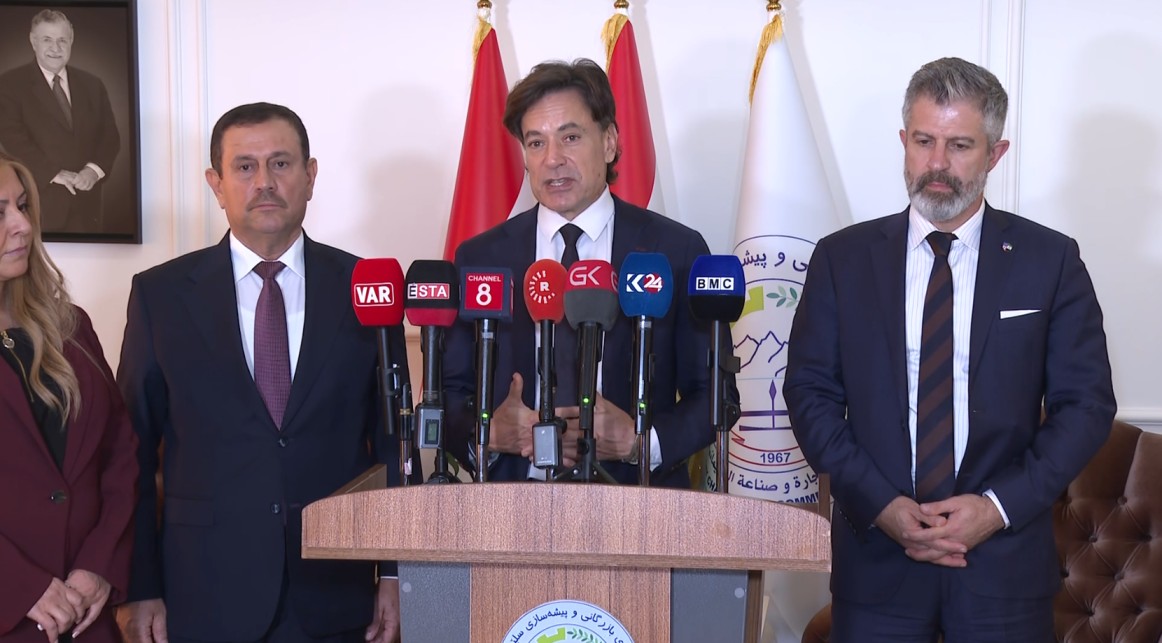
A high-level U.S. business delegation met with officials of the Slemani Chamber of Commerce to explore strategic investments across energy, defense, finance, and regional infrastructure, focusing on transforming the territory into a major gas hub and launching major trade projects.
Key Statements and Focus Area
- Slemani Chamber of Commerce President Nawzad Ghafour stated that discussions with the U.S. delegation “focused on strengthening relations and discussing the available investment opportunities in the city of Slemani that are suitable for American companies to operate in.”
- The U.S. delegation head, David Tafuri, stressed that Slemani is “a headquarters and a driver of industry and manufacturing, and that the people here are historically pro-business and they're traders.”
Speaking at a press conference on Thursday, Nawzad Ghafour announced that local officials held a successful meeting with an American business delegation led by USKBC President David Tafuri, alongside the Head of the Kurdistan Regional Government (KRG) Representation in the United States, Trifa Aziz.
Ghafour said that discussions were held between the delegation and companies from the city of Slemani across several different sectors, including energy, education, defense, and finance.
In his remarks alongside Ghafour at the conference, the head of the delegation and President of the U.S.-Kurdistan Business Council (USKBC), David Tafuri, emphasized, “We are very excited to be able to meet with some of the companies here.”
Tafuri highlighted that it had been particularly interesting because they observed both sides of the spectrum, noting that they had visited the Foundation Hub in the city, which supports new companies entering the market and startup firms.
He pointed out that the central message there was that Slemani and the Kurdistan Region of Iraq are “great places to try and start your business and look at how to provide services and products here in the region.”
Tafuri noted that the delegation is now engaging with the Chamber of Commerce, meeting with established, long-successful local companies whose central message welcomes foreign firms to view them as strategic partners when investing in the Kurdistan Region.
“So for American companies, we have small ones and we have big ones, and we are very satisfied to see this variety of options for potential partners here in the Kurdistan Region and in Slemani,” he added.
The USKBC President stated that regional conditions offer opportunities for American defense and security firms in the Kurdistan Region, adding that as the United States shifts its military posture, leading American defense companies "can now help fill the void left by the US military" alongside local partners.
Tafuri underlined that the region remains a vital, stable U.S. ally despite wider regional upheaval, as the delegation also includes oil and gas companies exploring expanded operations. He noted that several firms with long-standing investments in the Kurdistan Region are actively exploring ways to expand their operations.
Furthermore, he underscored that natural gas development presents major opportunities, stating that the Kurdistan Region should become a prominent gas supply hub for the Middle East to help replace reliance on countries like Iran.
He noted that beyond energy and defense, future infrastructure projects are expected to focus heavily on hospitality, logistics, and transportation to stabilize Syria's economy and boost cross-border trade.
Additionally, he clarified that a major initiative currently under discussion with the Kurdistan Regional Government is a potential new bridge linking the Kurdistan Region of Iraq directly to Syria, a large-scale project that American firms could back using available strategic financing.
FYI
The visit of this high-level American commercial delegation comes at a pivotal transition point for both regional politics and security. Organized by the U.S.-Kurdistan Business Council (USKBC), the trade mission aims to shift the nature of U.S. involvement in the region from military-centric assistance to deep private-sector economic partnerships.
This shift follows recent bilateral negotiations concerning the scheduled drawdown and posture modifications of U.S.-led Global Coalition military forces in Iraq.
The strategic focus on natural gas development aligns with ongoing regional efforts to secure energy independence for Iraq and position the Kurdistan Region as an alternative energy exporter, thereby undercutting regional reliance on Iranian energy imports.
Furthermore, the inclusion of infrastructure projects, such as the proposed cross-border bridge to Syria, reflects a broader geopolitical interest in stabilizing neighboring economies, securing transportation networks, and reinforcing the Kurdistan Region's status as an oasis of security and commercial logistics in the Middle East.
The U.S. delegation also met with Minister Shoresh Ismail and senior Ministry of Peshmerga Affairs officials on earlier this week to discuss the ongoing unification and modernization of Kurdish military forces.
The defense talks focused directly on aligning upcoming private American military infrastructure investments with the Peshmerga's new unified command structure.
U.S. representatives praised the Peshmerga's historic capabilities, emphasizing that the forces remain a foundational factor in maintaining regional peace and security as the broader U.S. military posture transitions.
Dive Deeper: Handpicked Stories for You
Follow Channel8 for continuous updates:
National Bank Opens Transfer Applications for Kurdistan Finance Employees
Slemani, Halabja Non-Oil Revenues Surge 10.8% in September
Slemani Summit Day Two Prioritizes Sustainable Infrastructure And Industry
1 hour ago